By Chris Olver, Project Archivist
In this post, our project archivist documenting HIV/AIDS archives in the UK highlights some of the history of HIV/AIDS sources currently available online.
A surprising aspect of my current work surveying HIV and AIDS records in the United Kingdom was discovering how much archival content was available to view online. Digitised records are rare beyond the family history websites and online picture libraries, due to various reasons but principally cost, time and legal restrictions on the records themselves. This is made even more complicated with records relating to HIV and AIDS, when factors such as Data Protection and ethical considerations often arise. This, however, has not prevented there being a wide range of documents, images, oral history recordings and videos relating to history of HIV and AIDS being made available by archives. In this blog, I will give a short tour of some of the digital collections and items relating to history of HIV and AIDS which can be found within UK archives and museums.
1) Online and downloadable archive records
The National Archives holds an extensive range of government records relating to HIV and AIDS, especially from 1985 to 1989 when the UK government feared that the epidemic would rapidly spread across the country and began a national public information campaign in 1987, where leaflets were delivered to every household in the UK and the “Don’t Die of Ignorance” television advertisements were broadcast.
Documents from this period, which can be downloaded, include the internal memoranda, reports and meeting minutes generated by the Cabinet Office Sub-Committee on Acquired Immunodeficiency Syndrome (AIDS) (reference CAB/5136) (Home and Social Affairs Committee: Sub-Committee on Acquired Immunodeficiency Syndrome… | The National Archives). It is even possible to read the comments of then Prime Minister, Margaret Thatcher, leading up to the public information campaign within the records of the Prime Minister’s office relating to the virus from 1985-1986 (reference: PREM/19/1863) NATIONAL HEALTH. Acquired Immune Deficiency Syndrome (AIDS): part 1 | The National Archives
You can find out more about the contents of these papers and others held by The National Archives through an online presentation by Mark Dunton, the Contemporary Principal Record Specialist at The National Archives.
2) Ephemera, printed material and posters
The most numerous online archive records are images of ephemera, posters and artefacts relating to HIV and AIDS epidemic. Ephemera is defined as printed documents of specific and limited purpose and there are numerous examples of flyers, leaflets, booklets, badges, posters and even condom packets found within UK archives and museums. The largest holding of this material can be found in the Wellcome Collection in London, which holds over 3000 downloadable images relating to HIV, including one of the largest collections of HIV and AIDS posters in the world (HIV | Images search | Wellcome Collection).
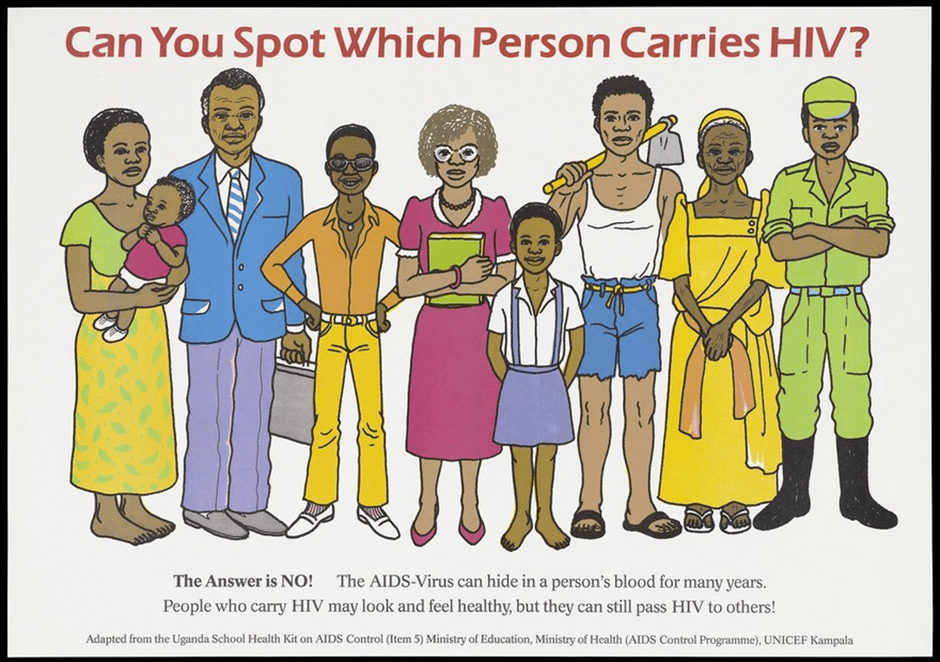
Credit: A group of men, women and children representing the difficulty in spotting who carries the HIV virus. Colour lithograph, ca. 1995 (?).
Ministry of Health, Uganda.
Wellcome Collection.
You can see other examples of ephemera through the online catalogues of collections at various museums across the United Kingdom including the Science Museum, Thackray Museum, National Museum of Wales and Museum of London. The museum collections also demonstrate the continued presence of HIV and AIDS in the UK through contemporary collecting of ephemera and artefacts relating to the roll out of HIV prophylactic medications, PreP or PEP, in the last few years. The Museum of Wales holds material from the Fast Track Cardiff and the Vale initiative, an international HIV prevention campaign material launched in 2020, which includes a branded face mask, an eerie example of two of our most recent pandemics meeting in one object.
The British Red Cross Museum also has number of digital images of their HIV holdings online including a poster created by the British Red Cross in 2006 which was featured within the 150 Voices digital exhibition to celebrate the 150year history of the Red Cross. An audio tour describing the significance of the poster can be found online here: Poster highlighting Red Cross programmes providing care to families affected by HIV and AIDS | British Red Cross
3) Television and radio programmes and advertisements relating to HIV/AIDS
Widespread mass media coverage of HIV and AIDS in the UK characterised the epidemic from mid-1980s onwards. The interest generated by the “AIDS scare” reporting in the UK newspaper coverage of the disease led a number of television and radio current affair shows, documentaries and news reports to be commissioned on the BBC, ITV and Channel Four. (https://www.bfi.org.uk/features/british-tv-aids-crisis)
There are many examples of television broadcasts of documentaries, talk shows and televised debates from 1980s and 1990s available online. The Wellcome Collection have uploaded some of their video collection onto YouTube, including some of the later Health Education Authority HIV awareness adverts promoting condom use. These ads are strikingly different in tone from the earlier ”Don’t Die of Ignorance” ad campaign, which was apocalyptic and focused on death, and instead use humour to persuade audiences to practice safer sex. In this ad from 1991, Fred Brewster cannot understand why the youth of today complain about using condoms and compares modern condoms to those around in his youth. He then shows the audience the reusable condom that he used to wear, which he nicknamed ‘Geronimo’, which he describes as feeling like you were wearing the ‘inner tube of a cycle”.
Online videos can also be found on the London’s Screen Archives website, which displays films from over 70 organisations in London. One of the films available, dating from late 1980s to early 1990s, is the deeply moving documentary, “Coping with AIDS”, that was created by Lambeth Council’s Health Liaison Unit. This aimed to destigmatise and document personal experiences of people living with HIV and AIDS in the community (https://www.londonsscreenarchives.org.uk/title/2517/).
An example of the television news coverage can be found in the Media Archive for Central England (MACE), a specialist public film archive for the East and West Midlands. The archive has digitised and made available online some of the regional news reports about HIV and AIDS from 1985-1989 and includes several reports which focused on the safety concerns of blood supplies and people who had caught HIV from contaminated blood products. These include a report on a controversial statement by then Conservative MP, Edwina Currie, on compensation claims for haemophiliacs contaminated by the virus in 1989 (https://www.macearchive.org/films/central-news-east-30111989-aids-edwina-currie).
There are many other examples of digitalised HIV/AIDS archives and online resources that I could not fit in. However, I hope to post a sequel to this blog as there are many more examples especially relating to oral history recordings and podcasts and community archive websites and channels. Thanks for reading!
Stay up to date with WSRO – follow us on Facebook, Instagram and Twitter

 West Sussex Record Office
One thought on “Margaret Thatcher to Geronimo: HIV and AIDS archives available online”