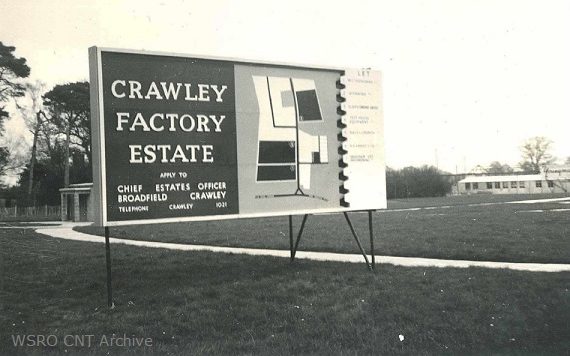
Manor Royal is a distinctive district of Crawley. It was earmarked early in the New Town’s planning stage as the perfect area to contain the town’s industrial pursuits. From its opening in the early 1950s, it has been home to factories, big and small, large warehouses, and offices. However, where once the district was a hub of light manufacturing, today Manor Royal is home to over 600 varied businesses, including Amazon, Thales, Virgin and Boeing.
This blog looks at how Crawley Development Corporation tempted two successful London-based businesses, plus several hundred employees, away from the capital after the Second World War.
Industrial tenants
One of the first stages of development of the master plan was to build what was initially termed the ‘industrial area’ – later named Manor Royal in 1950 by the then Princess Elizabeth II. This was to happen alongside the development of Northgate, Langley Green and West Green. The idea was that the first neighbourhoods could be home to employees of businesses located in the industrial area. The promise of brand new housing would encourage a strong and productive economy in Crawley New Town, and hopefully entice others from London.
“Before the war I lived in New Cross in Deptford… I wanted housing and I got a job here in Crawley at Metal Box and got my housing through Metal Box… I had to wait about six months for this place [house] to be built.“
Roy Foster in Crawley: Old Town New Town by Fred Gray (Lib 17237)
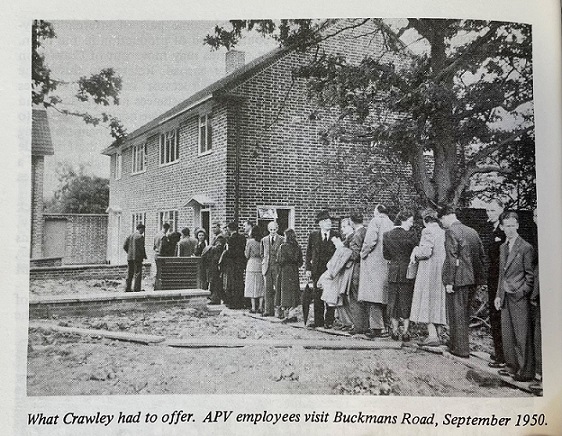
The Corporation was keen to attract businesses specialising in light engineering, such as the Metal Box Company, and those specialising in highly technical products such as the work of Edwards Vacuum. Crawley was fast becoming known as a national hub for this type of industry. Tours were often put on to show potential migrating families the housing available to them in the New Town. You can see employees from Aluminium Plant & Vessel Co (APV Co) viewing the exterior of homes in the image below.
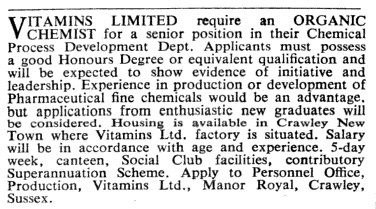
Two companies in particular attracted a significant number of migrants from London to the New Town. These were Aluminium Plant & Vessel Company (known as APV) and Silentbloc.
Aluminium Plant & Vessel Company
Founded: 1910
Initially based in: Wandsworth, London
Manufactured: Process equipment
Moved to Crawley: 1952
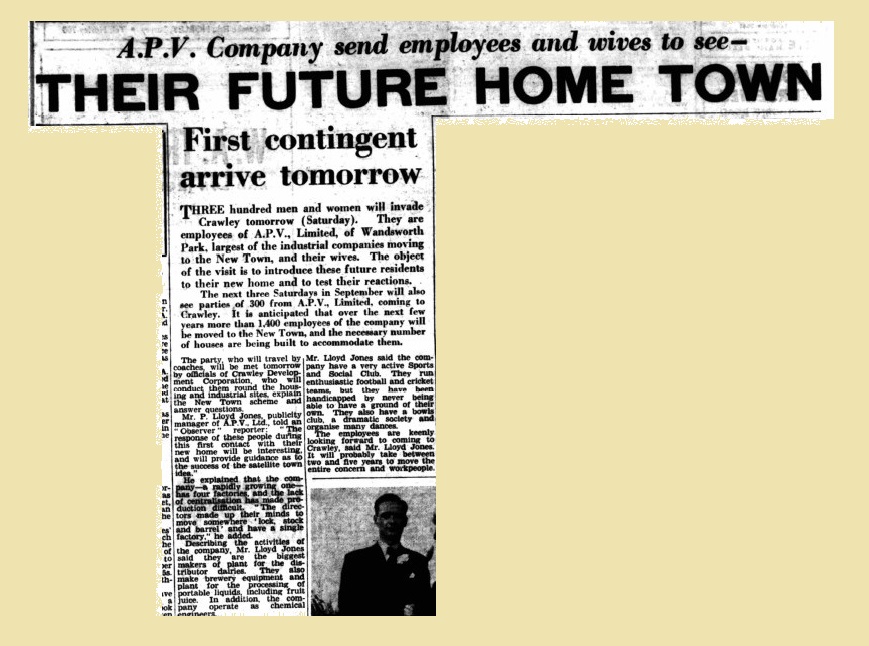
Known as APV, this company supplied (and still does today) equipment used by dairies, breweries, and chemical companies. This was exactly the type of light manufacturing that the Crawley Development Corporation intended for Manor Royal. APV became a significant employer of local Crawley residents, though many of the initial workforce were transferred from Wandsworth – where they were based – to Crawley. In 1950, the Crawley and District Observer reported on multiple visits of their 1400 employees and their families in order to view the New Town and the new homes that would be available to them.
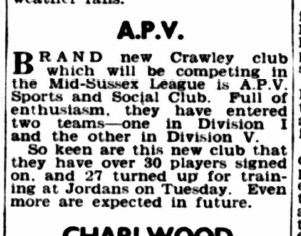
As such a large company, APV took steps to integrate themselves into the community in ways such as with the APV Sports and Social Club. This club was regularly featured in the sports section of the local newspapers. Match reports on the company’s bowling team received several lines, but it was the successes and loses of their football team that received the most attention. Both competed with other teams within the local community long after APV first came to Manor Royal.
Silentbloc
Founded: 1933
Initially based in: Notting Hill Gate, London
Manufactured: Vibration control products
Moved to Crawley: 1953
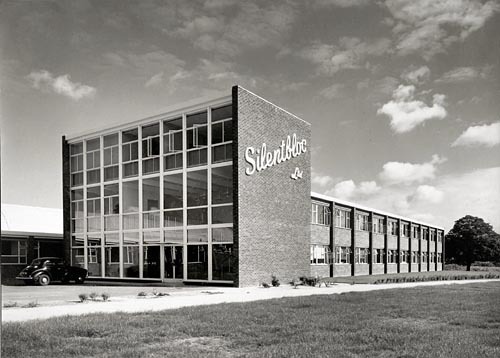
Silentbloc was initially based in Notting Hill Gate before its move to Crawley. Founded in 1933, Silentbloc designed and manufactured rubber components used to control vibration. Their products were used in cars and planes as well as having many other applications. It takes its name from its primary product called a ‘silent block’ – literally a tube-like element used to silence the noise of vibration.
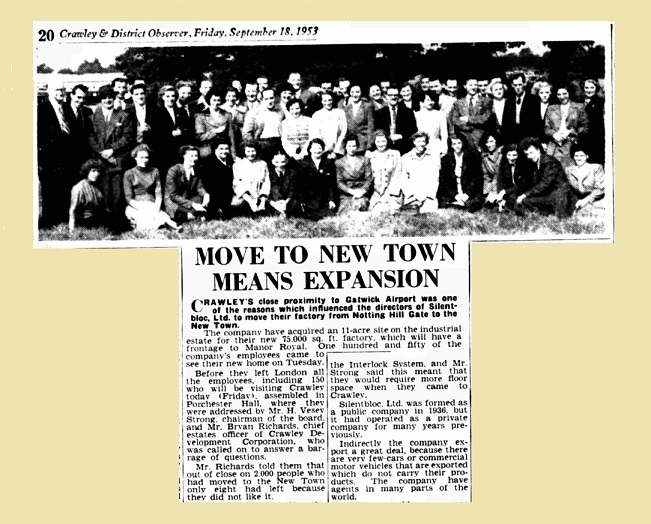
Prior to a visit of 150 Silentbloc employees to view the available housing in Crawley, the Chief Estates Officer Mr Bryan Richards made the trip up to Notting Hill to help convince them of its benefits. High up on the list must have been the potential for contracts generated by Manor Royal’s proximity to Gatwick Airport, which was in the process of being developed. A company manufacturing vibration control products for planes couldn’t be better situated.
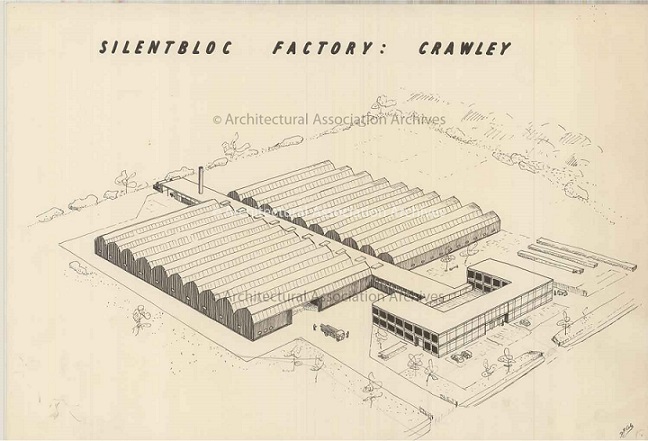
As well as the attraction of housing and an abundance of work for employees, the industrial area was drawing the attention of innovative new architects. Silentbloc had purchased an 11 acre plot for their new factory. In 1955, a fourth year Architectural Association School of Architecture student Douglas P. Cole sketched out his idea for the new factory.
Although never the most aesthetically pleasing area of the New Town, Manor Royal was absolutely crucial to its success and remains an important part of Crawley today. The Crawley New Town archive holds a large number of records documenting the decision-making processes in selecting the right factories for the area, and the minute books are full of references to the myriad of past and present companies occupying plots there.
Our next New Town blog will explore documents showing how life changed for existing residents of Crawley when the New Town began developing in 1947.

 West Sussex Record Office
Very interesting blog. My grandparents retired to Crawley in the 1930s and I went to live with them in 1950 when I was 4, so we all saw the New Town being constructed, literally around us, which was quite a big change for them but fascinating for me.
LikeLiked by 1 person