Please note that this blog post contains some graphic descriptions of injury.
By Victoria Evans, Searchroom Archivist
Working in an archive allows you the opportunity to stumble upon unexpected pieces of history and how it was recorded. As we answer enquiries on all manner of subjects it is sometimes too easy to fall down a rabbit hole of intrigue and our imaginations take hold as we desperately search for clearer answers. This blog will take you through the journey I embarked upon for answers.
With it being the month of October, and Halloween just on the horizon, my mind tends to drift towards the macabre and when our Research Assistant stumbled upon and read out to me a memorandum written in the front of a baptism register, I was hooked. It gave details of the cruel murder of Reverend John Denham by Richard Apps in December 1757. I was determined to find out more and delve deeper into the ins and outs of this heinous crime.
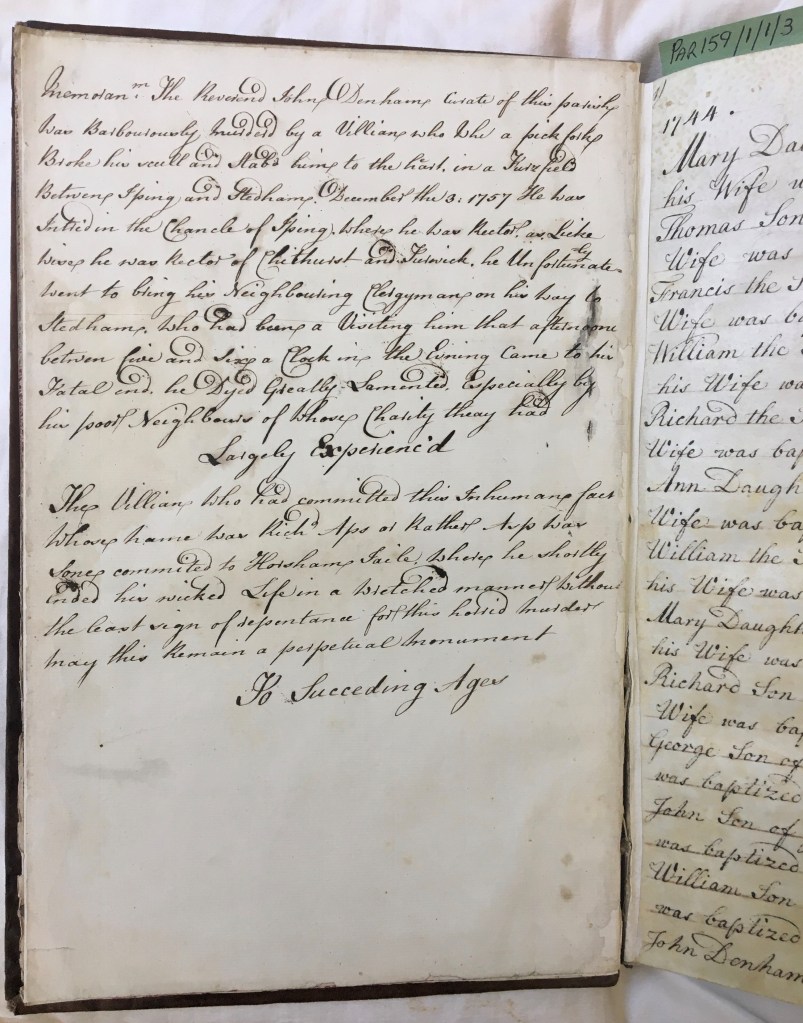
On December 3 between 5 and 6 o’clock in the evening, John Denham was walking back from seeing a neighbouring clergyman. This journey was abruptly ended when he was attacked and murdered between Iping and Stedham in or near a “furzefield” (gorse). The murder weapon that Richard Apps wielded was a pitchfork and according to this account he broke Denham’s skull and stabbed him in the heart. Apps was charged and sent to Horsham jail. Shortly after this he ended his own life while showing no repentance for his crime, in the eyes of who wrote this account.
A seemingly personal crime which leads one to think that there must be a personal motive to commit such a murder. This is where curiosity and the determination to learn more took hold. To commit such a crime it would be strange, but not unheard of, to not have a personal motive. This was no murder mystery, but it did pose a mystery motive that I set out to try and shed some light on.
Newspapers
Using the British Newspaper Archive (BNA) I was able to uncover five small snippets that were of most interest in my research. Just a moment to gush about the BNA but it such a valuable tool for any researcher to utilise. Being able to selectively search for specific terms is game changing. Rather than going through newspapers physically or trolling through microfilm saves so much time.
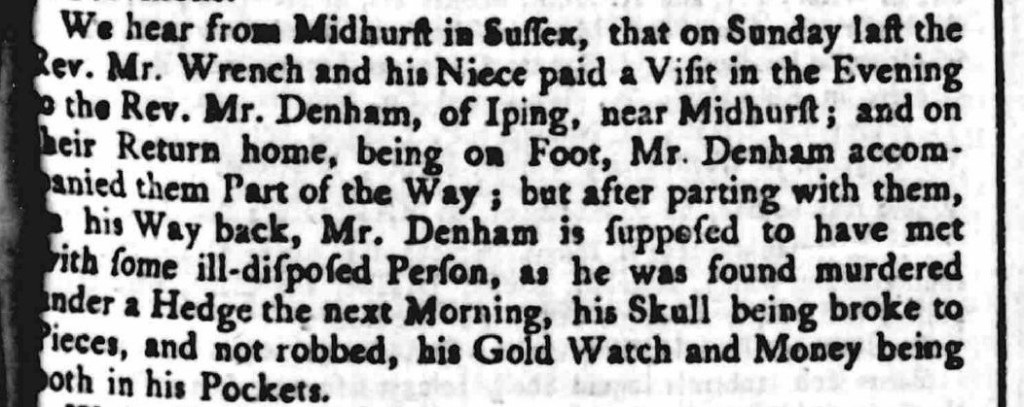
The first newspaper article that I encountered on the BNA was from the Oxford Journal on Saturday 10 December 1757. We learn more details about the lead up to the murder. Denham had a visited a fellow Reverend (Mr Wrench) and the Reverend’s niece. He then accompanied them for part of their journey home. After Denham had parted ways from his company, this was when Apps struck and murdered him. This article also goes into quite vivid detail about the injuries that Denham had sustained and reveals that the motive for this murder was not robbery as Denham’s watch and money were left behind.
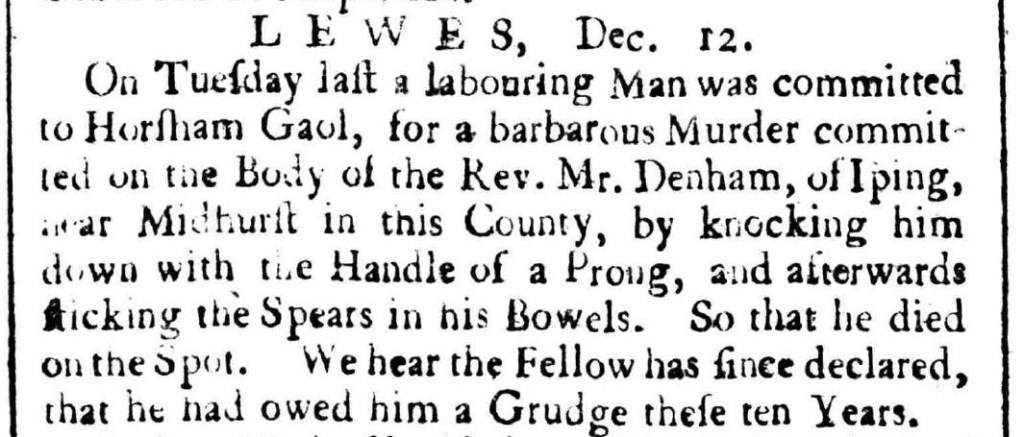
The next newspaper article from the December 12, 1757, edition of the Sussex Advertiser we begin to uncover more details about Apps and his personal motives that fuelled this murder. We learn that he was a labourer and that he had held a festering grudge against Denham for ten years. This grudge must have been potent if it were able to last for ten years and could only be resolved with the brutal slaying of Denham.
We can also pinpoint the timeline from the articles so far. The murder took place on the evening of Saturday 3 and the body was discovered on Sunday 4. Apps was then charged and sent to Horsham jail on Tuesday 6.
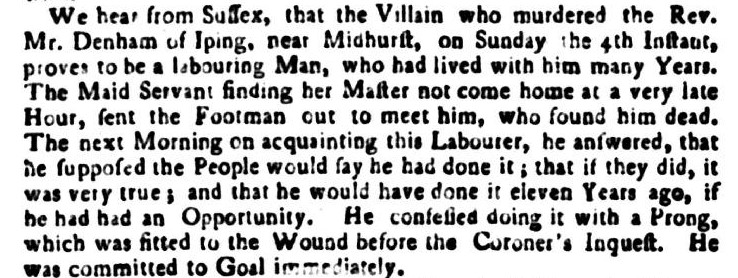
From the December 24, 1757, edition of the Kentish Weekly Post/Canterbury Journal some of the circumstances and working parts of the crime are revealed. Further adding fuel to the fire that this was a personal vendetta this article uncovers that Apps once resided with Denham. I cannot be certain of the reasons, but I can speculate that maybe Apps, being a labourer, was employed by Denham to do work at his home. However, a monetary debt was most likely not the motive as we have already learned that no robbery took place.
More details of how the crime was discovered are revealed in this article as we learn that Denham’s maid sent the footman out to find him as he had not returned as expected. The footman was the one that found his lifeless body. Additionally, this article also gave way to more clues about Apps’ mindset after committing this murder and how little he cared about if others suspected him. With his grudge festering for ten years, he may have got to the point where the consequences of such an act did not deter him anymore. He may have accepted that his fate would be doomed but at least he would have concluded his goal.
Further still, it very interesting to get a peek at how basic forensics were used to help aid securing charges against those suspected of a crime. In this case Apps had already confessed to using a pitchfork (“Prong”) as the murder weapon and this was matched up to the wounds present on the body. Of course, securing Apps’ confession was key in sending him to jail but also collecting forensic evidence would have helped to secure a conviction later down the line if this case had had its day in court.
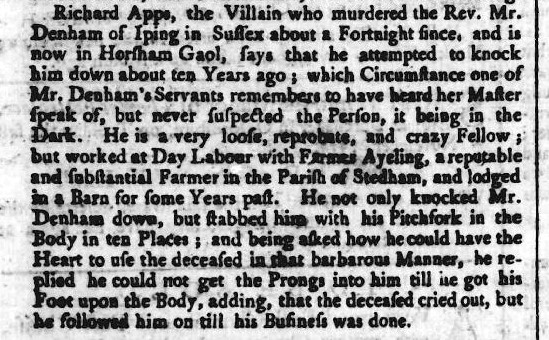
The following article is from the December 31, 1757, edition of the Oxford Journal and yet again we peer deeper into Apps’ motivations and longstanding feelings of distain towards Denham. Ten years before this gruesome incident the maid recalled how Denham was attacked but the culprit was not found, and no one even suspected Apps. This makes me question whether Apps kept his grudge against Denham a secret or whether Denham was oblivious to the loathing that Apps directed towards him.
This article then goes on to describe how Apps was viewed in the public eye as “loose, reprobate, and [a] crazy Fellow” but he was able to sustain a good reputation as a labourer for farmers in the local area. It is easy to believe that those around him may never would have expected him to be able to be so cruel to another person. Following this we then uncover more shocking details of how the murder was committed and how Apps viewed his act as “business” that needed to be taken care of. This leads me to think he that was able to detach himself from his crimes because his judgement was clouded by a long-lived rage against Denham.
This snippet came from the March 20, 1758, edition of the Sussex Advertiser. It confirms that Apps died in Horsham jail, however, it was implied in the handwritten entry in the baptism register that he took his own life. This newspaper does not confirm this neither does it disprove it. As this case never made it to trial no further details were explored further and the true motives behind this crime were never recorded. It should also be noted that even if Apps went to trial for his crimes, he may not have divulged his reasonings.

Concluding Thoughts
Although I have found some intriguing details from the newspapers, I cannot help but feel unsatisfied by what I uncovered. It is a realistic reflection of how research can sometimes feel lacklustre. I wanted to dig much deeper into Apps’ background, however, as I cannot be certain of his age or where he was born, I am unable to search through Ancestry or the Record Office’s parish registers with confidence. There are multiple ‘Richard Apps’ born in West Sussex and any one of them could be the ‘villain’ of this murder. I would also like to dedicate time to researching the background of Reverend John Denham.
My next steps will be to continue looking for Apps within parish registers and to try my best to work out which records are most likely him. In addition to this, I will search through the quarter session records (and potentially episcopal records too) to try and uncover more details about the details of his charge. I hope to return with updates in the future.
________________________________________
Stay up to date with WSRO – follow us on Facebook, Instagram, Twitter and YouTube

 West Sussex Record Office
Hello Victoria,
Thank you very much for this interesting research.
I came across the account of the murder written in the front of the Parish Register today whilst researching the Rev Edward Kimpton, Vicar of Rogate from 1785, and like you, I was intrigued to learn more. I was amazed to find that only relatively recently, you had done some research on it and saved me much time!
I live in Liphook not far from Rogate/Iping and often walk in that area. I wonder how many other locals “in succeeding ages” know anything about this macabre story. I’m sure the writer of the account would be glad to know that about 266 years later, people were reading what he wrote.
I note that the Clergy of the Church of England Database has some errors (it says John Denham died a natural death in 1734 and 1735, but then goes on to list his appointments up to 1756!)
https://theclergydatabase.org.uk/jsp/persons/CreatePersonFrames.jsp?PersonID=63306
I do hope you have a break-through and find more details for Richard Apps, although I think it will be a tough one, as I noted on Ancestry that there are also many Richard Aps as well as Apps!
Thanks again,
Heather Boosey
LikeLiked by 1 person
Thank you for your encouraging words, Heather. This was my first blog that I researched and wrote so I am glad you enjoyed it and found it interesting.
And you are right that the Clergy of the Church of England Database have made some errors on John Denham’s entry. I will try getting in contact to see if this can be amended. Thank you for pointing this out.
Although I’ve not had a break-through yet, I have found something of interest that I will eventually be part of my update in the coming months.
Best wishes
Victoria
LikeLike
Intriguing – I look forward to seeing what you have found. Happy researching!
LikeLiked by 1 person