By Chris Olver, Project Archivist
The 1st of December is World AIDS Day, the international day dedicated to raising awareness of the HIV/AIDS epidemic. This year marks the 36th World AIDS Day since it was launched by the World Health Organisation in 1988. To commemorate this year’s World AIDS Day, our Project Archivist, Chris Olver, has looked through the WSRO archives to see how the day has been celebrated across West Sussex.
Slow beginnings, 1988-1991
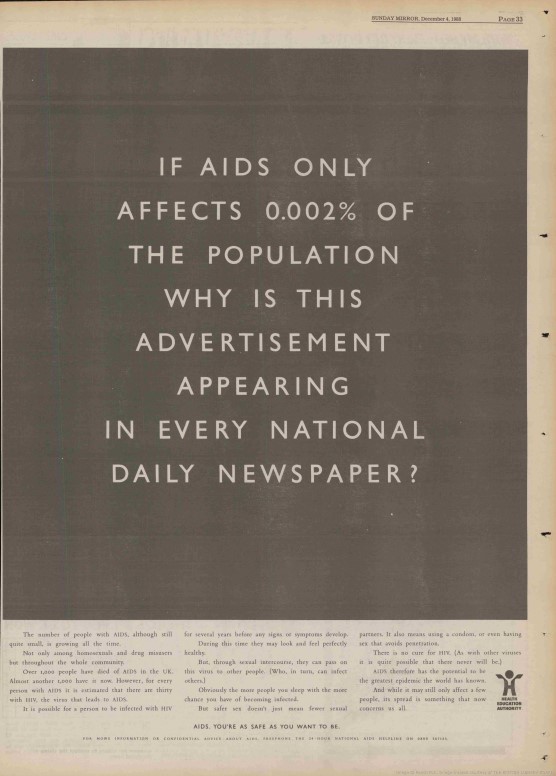
The first year of World AIDS Day in the UK started slowly. The government marked the date by launching a new Health Education Authority (HEA) HIV and AIDS awareness campaign. There was an increase in national press coverage and television programmes broadcast, though these typically were repeats from the 1987 ‘AIDS Week’ broadcasts where programmes about HIV/AIDS were shown across all the terrestrial channels. It was not until the following year that I found the first reference to World AIDS Day in the WSRO archives. The Lancing Herald on 1 December 1989 wrote a short article about a response from Susan Quinn, an AIDS Counsellor in Worthing, responding to criticism that too much money was being spent on AIDS in the local area. In the article she stated: “[to] increase AIDS consciousness on World AIDS Day [they had] been producing circulars for all Worthing Health Authority staff, information has been displayed in prominent places, such as dining halls, and details of training courses on AIDS counselling have been made available”.
This lack of local coverage was not surprising; whilst numbers of HIV cases were relatively low in comparison to other parts of the country, the stigma associated around the disease often meant local services were not widely known with Susan Quinn commenting “obviously we have kept a low profile because of the nature of the disease”.
Things were to change in the early 1990s. The medical historian, Virginia Berridge, writes that this period saw the ‘normalisation’ and ‘mainstreaming’ of AIDS through popular entertainment. This was seen through prominent storylines in television soaps like EastEnders and Brookside, but also the publicity and public sympathy towards the illness and death of public figures with the disease, most notably Freddie Mercury in 1991.
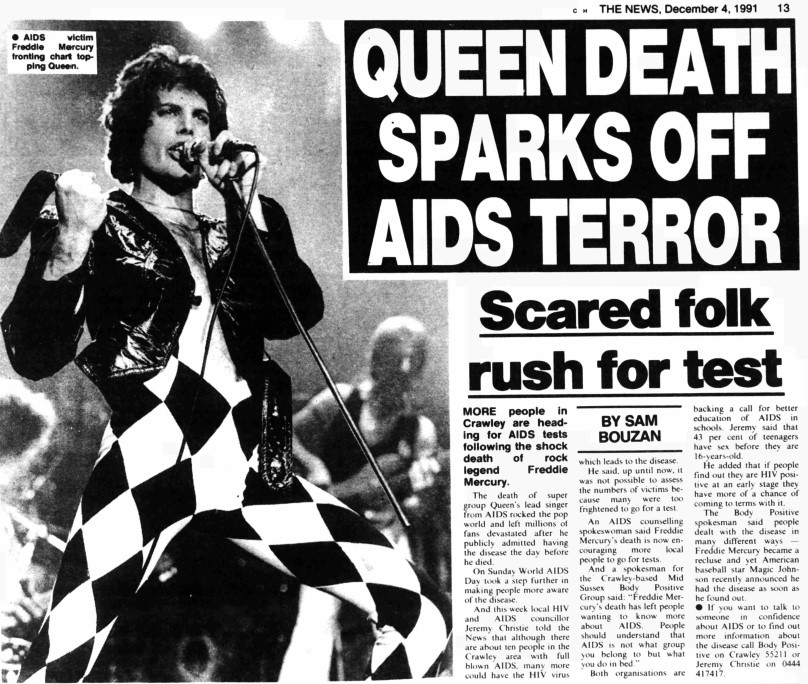
Freddie Mercury’s death on 24 November 1991 fell one week before World AIDS Day, and its impact was still strongly felt a week later as the article below from the Crawley News reflects. The article states how his death had encouraged more local people to get tested for HIV and find out more about the virus. The article quotes a spokesman from the Mid-Sussex Body Positive Group saying: “Freddie Mercury’s death has left people wanting to know more about AIDS. People should understand that AIDS is not what group you belong to but what you do in bed”.
World AIDS Day takes off
From the early 1990s onwards, World AIDS Day events began to proliferate, and the red ribbon pin, which is now the universal symbol of awareness and support for people living with HIV, began being worn by people throughout society, and not just by those directly affiliated with the cause.
West Sussex was no exception, in 1992 the Worthing Area HIV Support Group, asked passers-by in the Montague Centre arcade to use coloured shapes to complete a ‘patch’ on a quilt. The Worthing Health Authority HIV prevention adviser, Thelma Dines, who helped organise the event, stated that “most people seemed to be more tolerant about the AIDS issue, especially people who had been educated about the topic at school”.
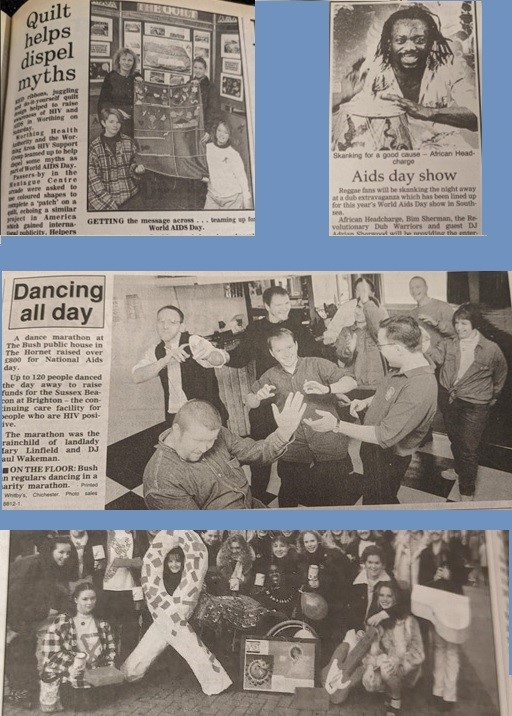
Across West Sussex, other fundraising and awareness events were taking place: a reggae benefit concert in nearby Southsea was being advertised in the Chichester Observer in 1993; a student artwork competition at the Thomas Bennett School in Crawley; a World AIDS Day church service in Pagham; health and social care students from Bognor Regis Community College raised nearly £600 for the Terrence Higgins Trust; and Worthing buses advertising AIDS telephone information lines. Perhaps the most novel fundraising event was a dance marathon organised at the Bush public house in Chichester in 1996 which raised £800 for the National AIDS Trust. These events were often arranged by local HIV charities, but also by people with no formal involvement or association with HIV, such as college students.
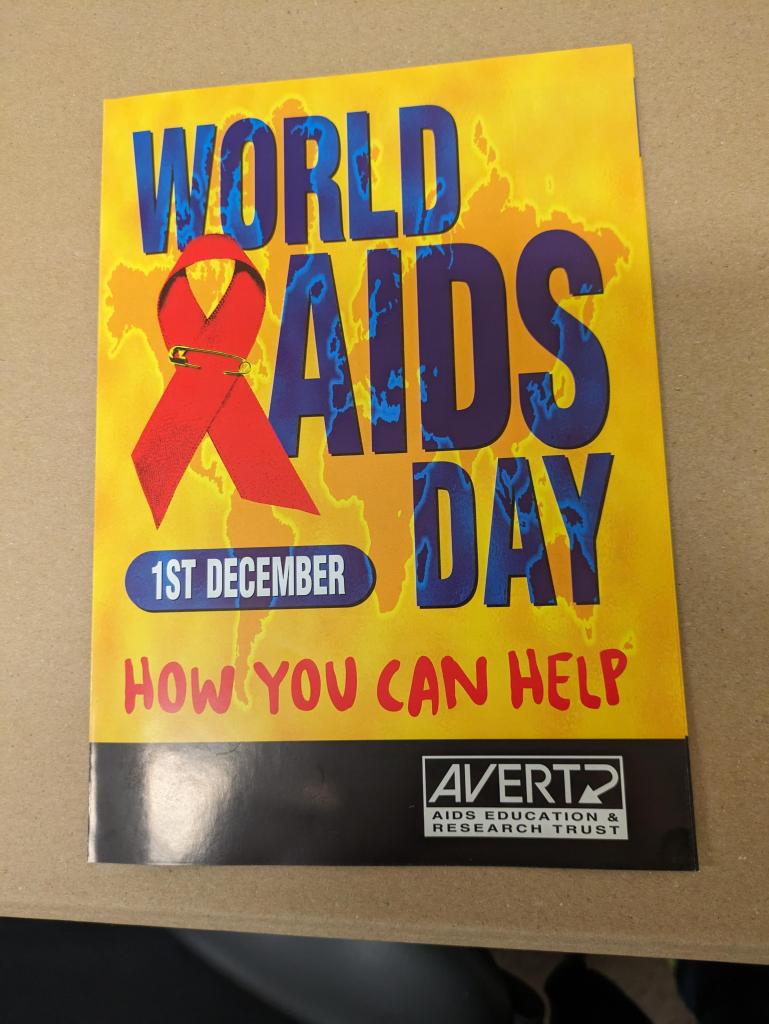
The Horsham based HIV and AIDS charity, AVERT, had been marking World AIDS Day since its inception but during the 1990s, demand for their HIV/AIDS educational material dramatically increased. The 1996 World AIDS Day had a particularly high profile. The charity gave away or sold a total of over 150,000 red ribbons, and over 1,000 education packs were sent out to organisations holding events.
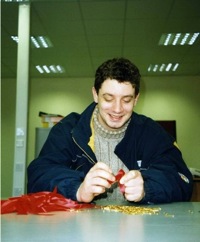
By the end of the decade, World AIDS Day events were becoming more expansive. The HIV organisation, Mid Sussex Body Positive based in Crawley, spent the week preceding the 1998 World AIDS Day undertaking various activities. From handing out red ribbons and collecting money in the town centre to distributing free condoms at local nightclubs. The group also received a small grant to create a giant red ribbon to display at Gatwick Airport.
Whilst these displays helped to raise awareness and much needed funds for the local organisation, they still were encountering a lack of awareness about HIV/AIDS as Dierdre Love, co-ordinator of the charity, told Crawley News on 9 December 1998: “It’s quite surprising how ignorant people still are, some didn’t want to wear red ribbons because they thought their friends would think they’re gay. It’s nothing to do with being gay, it’s just showing you care”.
Living with HIV
Most of the West Sussex press coverage that I have found relating to World AIDS Day, centred on local fundraising initiatives to mark the day. The press coverage rarely featured direct quotes from those living with HIV, but there was one exception. In a 1997 article for the Crawley News a recently diagnosed man named Philip [was interviewed?] for the newspaper.
Philip describes for the paper how he remembers hearing about his diagnosis and the response from his family:
“My immediate reaction was denial. I then felt immense fear, shock, disbelief guilt and blame. I felt a whole new path of emotions because it’s such as unique thing.
My mum thought that being HIV positive meant that I had AIDS. There is a difference. HIV is the virus that can lead to AIDS, but through the medication I’m taking I’ve got more chance of dying of old age. When I told my family they became distant, and the hugs and kisses stopped for a while. There is still such a stigma attached to HIV. It’s not a gay issues or heterosexual issue – it’s a human issue”.
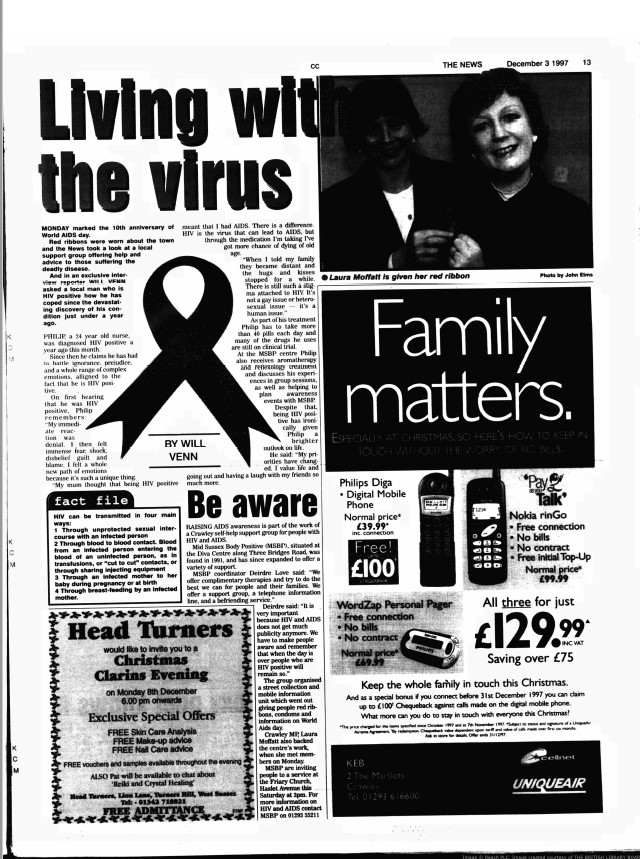
The article goes on to state that Philip was taking more than 40 pills a day for his treatment. Today, standard dosage of HIV antiretroviral medication would be 1 to 2 pills a day. Those on effective treatment for 6 months or more can no longer pass the virus on. The progress that has been made in the last few decades means that the UK is on course to stopping new cases of HIV in the UK by 2030. Yet HIV in the UK has not gone away. Over 105,000 people live with HIV in the UK, and they still face significant discrimination and stigma. It is important to continue to do things like wearing a red ribbon to show support for people living with HIV and globally pushing for the end of AIDS.
You can find out more about World AIDS Day 2023 on the National AIDS Trust website, here.
Stay up to date with WSRO – follow us on Facebook, Instagram, Twitter and YouTube

 West Sussex Record Office