By Dr Caroline Adams – Guest Speaker
In the late 16th century, the estimated population of Chichester was about 4000 residents (now it’s about 33,000). Four thousand is about the same population as some of the present-day villages around Chichester – Tangmere or Fishbourne, for example. When you walk around those villages, it feels quite empty – you are not often stepping off the kerb to avoid groups of people. So, even on market day, Elizabethan Chichester would have felt different – you might be the only person in the shop.
This might explain the size of Chichester Cross, built in 1501-02. It’s not large – probably about the right size for about eight traders – one on each side, perhaps? How would they have arranged themselves – would they face outwards, with their stalls between them and their visitors? Which was the best position to have? – facing North Street where markets were held on Wednesdays and Saturdays, or facing the West Street to catch all the people involved in court business?
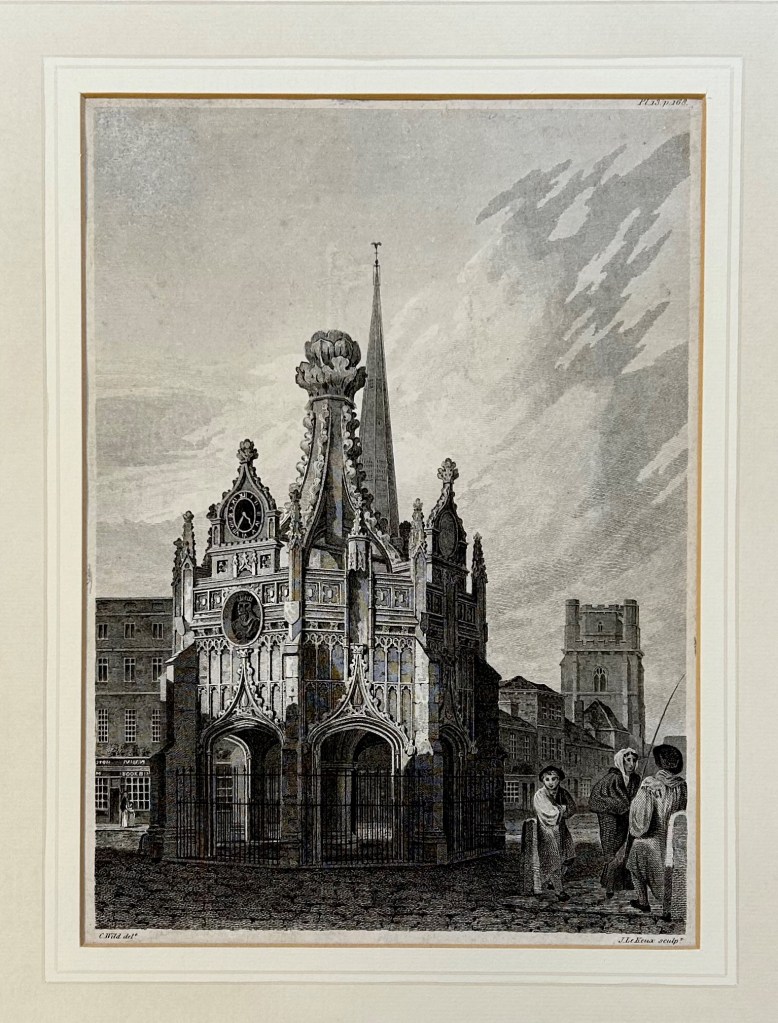
View of Market Cross, Chichester, c. 17th century
Even more interestingly, it was the Bishop who had caused the Cross to be built there, bang in the middle of the market town. On its sides he put lots of his own and his family’s heraldry, and little figures of himself, which have long since disappeared. Ostensibly the cross was built for the poor people of Chichester to sell their wares without having to pay local taxes – how were they chosen? As we have seen, it didn’t hold very many traders. Or was the Bishop just putting a reminder of himself and his own power and wealth in the middle of the city which held the seat of his diocese?
Evidently it was important to show off your importance to the people of Chichester, and to display your wealth if you had it. North Street was the home of some very successful merchants who traded through the port of Chichester and who would regularly take business trips to London. Their houses would have had a wide street frontage, and barns and warehouses behind. Some had shops within them; sometimes they would look like the Horsham shop at the Weald and Downland museum, with a counter and open window so that you could see the wares on shelves behind the shopkeeper. Other shops were a bit more exclusive; customers would go in through the front door and do their shopping inside.
So, it is possible to see how, by using traditional local history research, and revisiting it from the viewpoint of material culture, we can begin to see how life might have been lived in Elizabethan Chichester. Join me at the West Sussex Record Office for an evening of further exploration on 26 March at 7pm.
Tickets cost £8.00 (attending in-person), £7.00 for West Sussex Archives Society members, £5.00 (attending remotely via Zoom). To attend in person, please phone 01243 753602 to book and pay. To attend online, please book via Eventbrite.
Stay up to date with WSRO – follow us on Facebook, Instagram, Twitter and YouTube

 West Sussex Record Office