
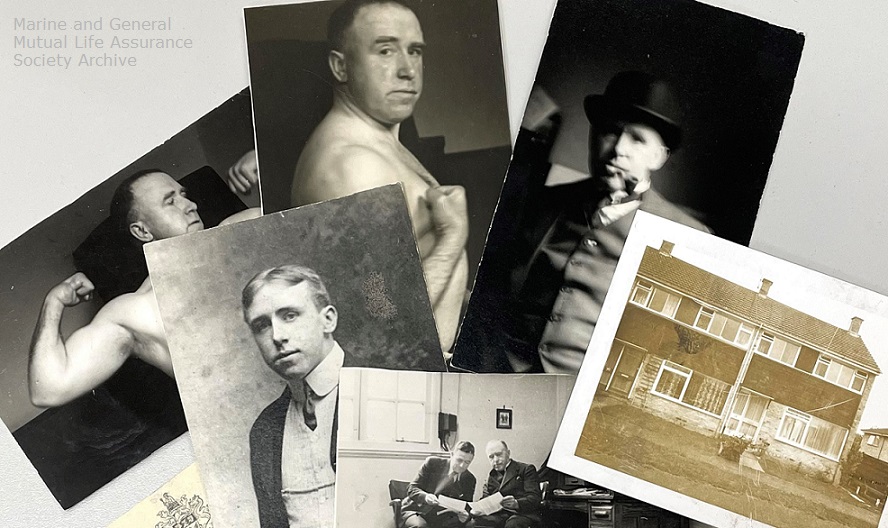
In August 2024, the Record Office was awarded a grant by Lloyd’s Register Foundation as part of their small grants scheme to fund the cataloguing of the Marine and General Mutual Life Assurance Society Archive, deposited at WSRO in 2015. The work has now been completed, and the collection is accessible to users in our searchroom. To introduce the archive, this blog will take a look at the life of one of the Society’s employees, Ted Rogers, who worked across their Liverpool and Leeds offices. The trajectory of Ted’s life has synergies with major events in the life of MGM, which started as a maritime life assurance company, making Ted an ideal person to tell MGM’s story through.
Early years
Ted’s father, Edward, was born in 1857, just five years after Marine and General (MGM) was established. Originally from Ireland, Edward, like many thousands of Irish people between the 1840s and 1880s, made his way to Liverpool and worked in the marine industry. He married a Liverpudlian woman called Mary Burns and began a family in the district of Toxteth. Ted, named after his father, was born in Toxteth in 1895 the year after his parent’s marriage. The Rogers family were Roman Catholic, as were a large proportion of Liverpool’s community, so events such as baptisms and marriages were held at their local Catholic Church. Edward’s occupation was arduous. At various points he appears to have worked as a captain of a dredging boat and also as a mariner. At this time, Liverpool was a centre of trade and its boundaries were expanding, its docks included.
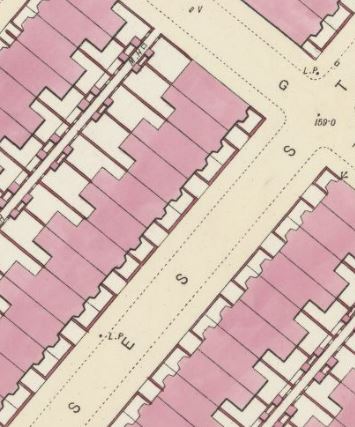
According to the 1901 census, Ted and Edward are living in Toxteth with Mary, the family’s matriarch, and two young daughters Alice and Mary. However, by the 1911 census, Edward had died and left Mary a widow, trying to support her family through work as a charwoman. I searched for Edward on burial records, death registration indexes, and newspaper articles, but to no avail. Without details on Edward’s death, we’re left to assume that his strenuous and dangerous work may have taken its toll. Life assurance was nothing new in Britain, but MGM understood the elevated risk that a life at sea had upon mortality rates, and saw an opportunity to market assurance to seafarers. The first minute book (MGM 1/2/1/1), dating from MGM’s foundation in 1852, shows that key companies in the maritime industry, such as P&O and Cunard, were involved, reflecting the importance of this scheme. Edward does not seem to have bought a life policy with MGM (I can’t find him in the policy registers) but perhaps would’ve benefited if he had.
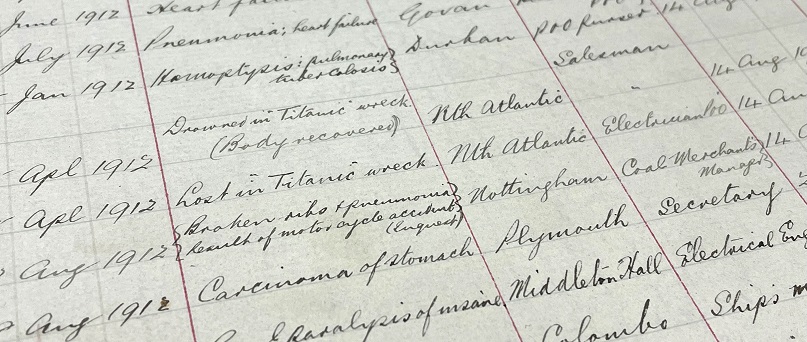
In 1912, Liverpool’s seafaring community suffered a horrendous shock when the RMS Titanic sunk on 15 April. Although the ocean liner hadn’t been constructed or launched in Liverpool, the White Star Line – who’d built the Titanic – had their head office in the city and a long legacy of launching ships there. There were a significant number of crew members and passengers on board who hailed from Liverpool. The MGM Archive includes an extensive series of registers of life policies and claims dating from 1852 to the 1970s (MGM 7/1/1 – MGM 7/1/27). In a register of death claims (MGM 7/3/2), 1895 to 1918, two claims appear for victims of the disaster –
- Joseph Fynney, aged 35, salesman [link to external page]
- Albert George Ervine, aged 18, electrician for P&O [link to external page]
Albert had bought his policy just six months prior to his death.
At the time, the Rogers were living just a 20 minute walk from Joseph Fynney’s home in Toxteth, and a ten minute walk from his parish church of St James. Fynney was just one of hundreds of passengers and crew members who had links to the city. How did this news affect the teen-aged Ted? I can’t speak for him, but I know it would have struck a chord with me. Such loss at the hands of the sea, so soon after his mariner father’s death, must have had an effect on Ted’s outlook on life.
War and maritime peril
Amongst a bundle of photographs of Ted, there is one of him as a young man aged 17, having just commenced his apprenticeship with ‘United Kingdom T & G Mutual Life Assurance Society’ (as Ted has written on the back of the image). I’ve not been able to confirm the name of the company, but it could have been the Temperance and General Provident Institution. Just as Ted was getting underway with his apprenticeship in insurance, the First World War broke out.
A little digging around on Ancestry suggests that Ted served in the Royal Dublin Fusiliers as a Corporal from 1915 to 1916. His claim to a place in the regiment made credible through his Irish father. The ‘Dubs’, as they were known, saw action at the Western Front, Gallipoli, Middle East, and Salonika. Sadly, more than 60% of service and pension records of soldiers in the First World War perished in bombing raids in London during The Blitz, and I haven’t been able to find more on Ted’s possible service history.
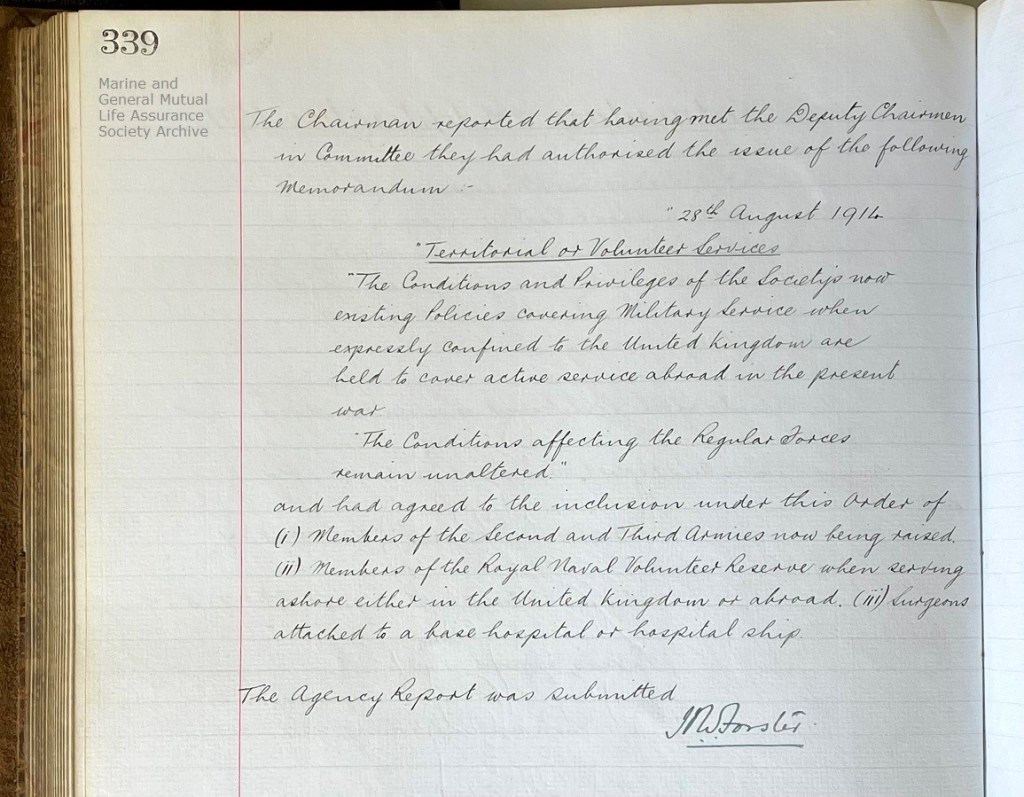
The impact of the First World War upon the life assurance industry was unprecedented. By this time, MGM’s portfolio of policy holders extended far beyond just mariners; looking at the above register (the one containing the entries for Titanic victims), you notice occupations of all sorts not to mention the variety of ages of (predominantly) men purchasing their first policy. This meant that MGM had a great many men on their books who were eligible to serve in the British Army. But, this presented a problem. The risks of choosing to go to war on such a scale as this was not something that MGM had given significant consideration to. And, of course, the business of insurance is based upon measuring risk. However, in August 1914 MGM chose to honour those claims made against policies held by fallen servicemen, and did not increase premiums for those who signed up.
The ‘golden age of cruising’
After the armistice of 1918, the cruise industry took a few years to recover and recoup passenger numbers. During the 1920s, the insurance of passengers and baggage grew in popularity, reflecting a rise in global tourism, in particular transatlantic crossings to North and South America. By 1935 MGM was selling more policies than ever before, and by 1938 their Assurance Fund was nearing £4 million. Of course, even during the inter-war period, cruising was still a luxury really only open to the rich and upper middle classes. But the lure of cruising and global travel didn’t appeal to Ted. In 1922 he married a woman called Ellen Duggen, settled down in Wavertree in Liverpool, and started a family.
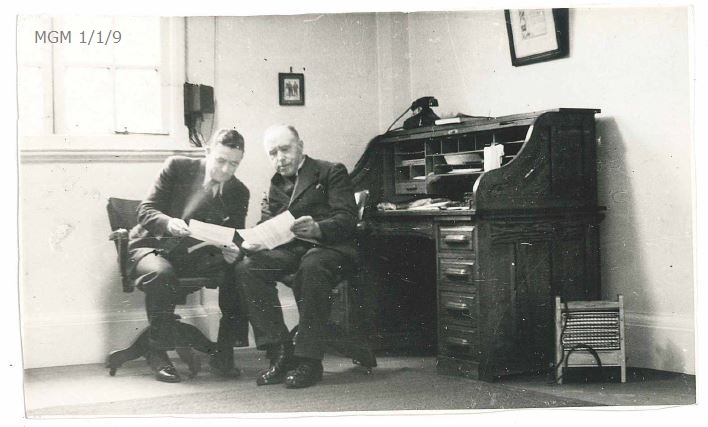
It’s around this time that MGM began to promote insurance and assurance products specially aimed at married couples and families, as well as products to assure the lives of children. I have wondered if Ted ever took out a similar policy for his growing family. By 1939, Ted and Ellen’s firstborn Mary was also working as a shipping clerk – and I like to think she was working at MGM alongside her father. The Second World War was another significant worry for MGM, but this time they were more prepared. By this point, Ted himself was beyond the age to enlist (although he still enjoyed athletics, which explains the photos of him baring his muscles), and so he continued his role as ‘baggage master’ from MGM’s Liverpool office throughout the war.
The war ended and by the mid 1950s, Britain was recovering and the surprising growth of the economy was allowing families more expendable income. International holidaying was becoming more accessible, and not everybody saw the appeal of flying. Some called the 1930s-1950s the ‘golden age of cruising’ where it peaked and became synonymous with ‘old-world’ glamour, whilst being a world away from the disasters that were the Titanic and Lusitania. I am sure that Ted would have been kept busy with the insurance of passengers’ baggage during this period.
Later years
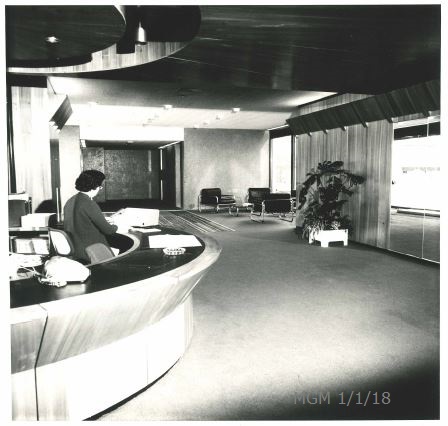
In 1974, the headquarters of MGM moved from central London – breaking with centuries-old ties with banking and insurance markets – to Worthing, West Sussex. They bought the site of the Heene Road Baths and built what was then a remarkable sleek and modern office, and there they stayed until their dissolution in 2015. Worthing was, of course, even further away from Liverpool than London, but that needn’t have bothered Ted, who retired in 1954, having spent almost two decades of his working life with MGM.
And so Marine and General were kept busy assuring lives into the 21st century, but not just of mariners and passengers as they had successfully built a name for themselves so much so that anyone could take out a policy regardless of profession. Through the life of their business, MGM witnessed significant periods in British and global history, weathered financially risky times, and took part in the evolution of seafaring from a perilous activity undertaken largely by sailors, to a leisure pursuit enjoyed by many.
You can search the newly catalogued MGM Archive by searching for “marine and general” in our online catalogue.
Stay up to date with WSRO – follow us on Facebook, Instagram, Threads and YouTube

 West Sussex Record Office