By Nichola Court, Archivist
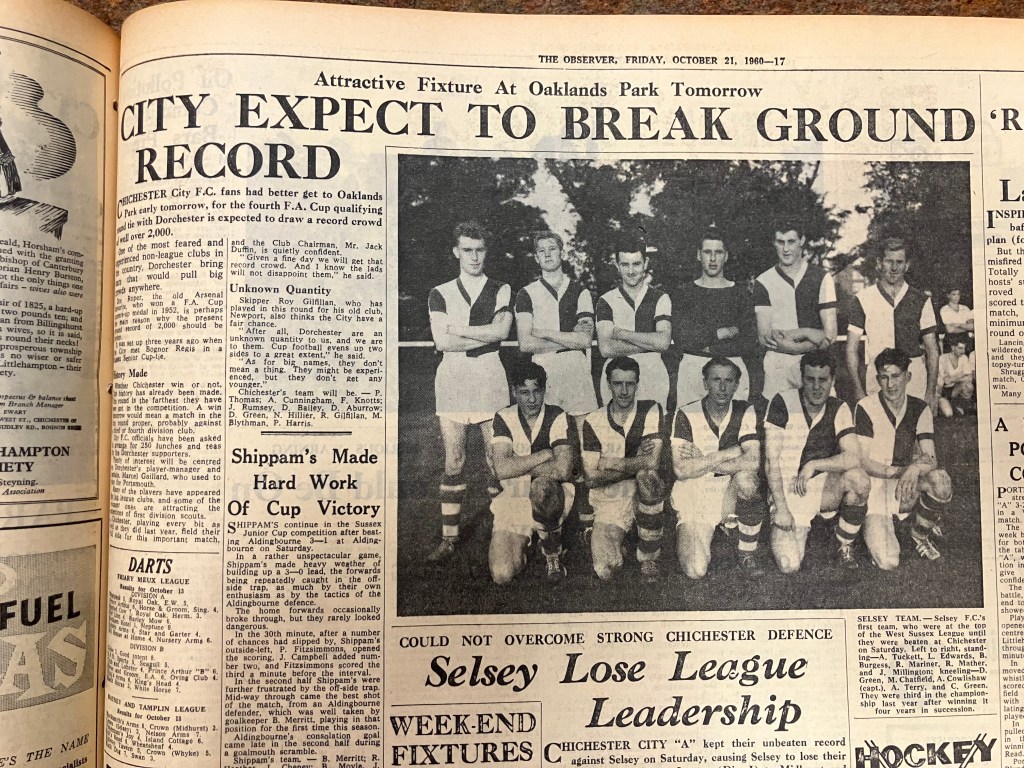
Oaklands Park is Chichester’s largest open space, famous for housing the annual Sloe Fair, the Festival Theatre, a large mansion hidden in the trees, now used by the University, and many of the city’s sporting clubs. These clubs include Chichester City United football club, which was formed in 2000 after Chichester City and Portfield football clubs merged. Oaklands Park was the home ground of Chichester City FC, which was founded in 1873, and was the scene of several exciting matches during Chichester City’s memorable, record-breaking run to the first-round proper of the FA Cup in 1960.
Having won the Sussex County League the previous season, Chichester started the 1960/61 season in fine form and were top of the league by the time they faced Cowes in the second qualifying round of the FA Cup. In an exciting game at Oaklands park, Chichester beat Cowes 6-3, soring two goals in the first 11 minutes. Captain Roy Gilfillan, right-wing Dave Green and left-back Freddy Knotts were the stars of a Chichester side which, according to the Chichester Observer, ‘had seldom, if ever, played better’.
Chichester’s progression continued with a third-round home win over Andover. A tight match played on a muddy, waterlogged pitch saw City grab a 2-1 victory over a strong side. The win set up a fourth qualifying round tie against Dorchester Town – ‘one of the most feared and experienced non-league clubs in the country.’ The game – again played at Oaklands Park – generated much excitement, with the Chichester Observer following the team during their training and preparations. Reporting them to be a strong and happy side, Dorchester Town were warned to ‘watch their step’, since Chichester ‘could not be fitter, or in better form’.
Dorchester obviously did not heed the warning as a record crowd of more than 2,000 watched Chichester earn a brilliant 4-1 victory. With Dorchester competing in the professional Western League and fielding a team which included Don Roper, formerly of Arsenal, and Marcel Gillard, formerly of Portsmouth, Chichester’s amateur side truly excelled themselves. Having celebrated each of Chichester’s goals with a cacophony of noise from bells, bugles and rattles, the crowd went mad when the final whistle blew and, with Chichester through to the first-round proper, Cup-tie fever descended on the city.
On November 5 the team, accompanied by more than eight coaches carrying more than 400 spectators, set off for the biggest match of their lives. Drawn to face Bristol City at home, Chichester instead elected to play away, believing Oaklands Park to be too small a venue to cope with such a big match. Third-division Bristol City boasted some big-name players including: Tommy Casey, formerly of Portsmouth; Bob Etherbridge, who also kept wicket for Gloucestershire; John Ayteo, a former England player; and Alex Tait, newly-transferred from Newcastle United at a cost of £5,000.
Sadly, Chichester’s FA Cup dream ended that day, with Bristol City proving to be too much of a challenge. The Chichester Observer reported that Chichester were ‘mesmerised by the skill of the Bristol forwards, and were unable to start up any attacks of their own’. A final score of 11-0 reflected badly on Chichester goalkeeper Peter Thomas, but he saved many more goals than he let in.
Chichester’s FA Cup run might have ended that day, but the side did not go home empty-handed. For a start, their share of the gate earned them £700, with 12,500 spectators entering the ground. But perhaps what was more valuable was the experience of playing a third division side, which inspired the club to go on and have its most successful season ever.
Chichester City went on to reach the first-round proper of the FA Amateur Cup, where they lost to a formidable Working side which contained several of the players who had won the Cup in 1958. They also reached the semi-finals of the Sussex Senior Cup; shared the Sussex RUR Charity Cup, drawing the final against Brighton & Hove Albion; and were Sussex County League Champions for the second season running, remaining unbeaten until they met Lancing on April 2nd.
Chichester’s taste of FA Cup glory might have been short lived but for both the players and the 400 spectators who travelled to Bristol, it was an unforgettable experience.
—
Although Oaklands Park is Chichester’s largest open space, it did not become a public park until 1938 when it was acquired by Chichester Corporation from the Henty family, prior to which its history is curious, complex and hitherto unexplored.
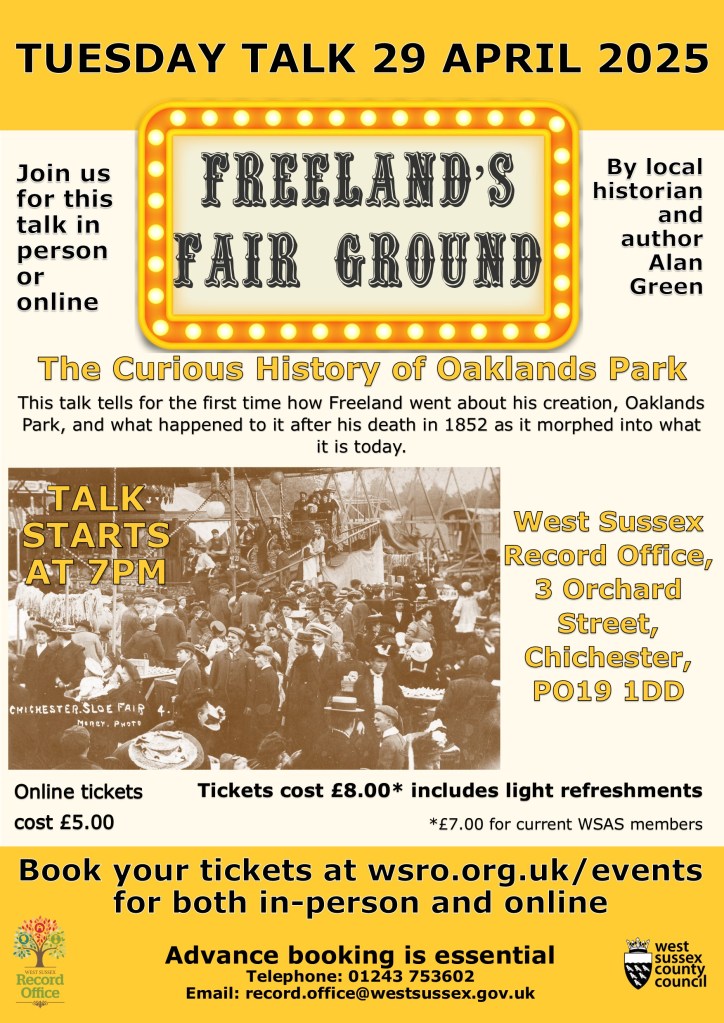
Oaklands Park as we know it was the 19th century creation of one man, James Bennett Freeland, a wealthy lawyer who started acquiring the necessary closes of land in 1819 to create his own private park and finally completed it in 1850. On Tuesday 29th April, local historian and author Alan Green will explore the history of Oaklands Park. Alan will explain how Freeland went about his creation and what happened to it after his death in 1852, when the area morphed into what it is today.
Please note that the main text of this blog was written from the Chichester Observer’s ‘Down Memory Lane’ feature and was first published in Chichester Observer on January 17th 2008.
Join us on 29 April at 7pm for this Tuesday Talk in person at the Record Office or online via Zoom. The talk will last up to an hour, with an opportunity to ask questions (via the chat box for our remote audience).
In-person tickets cost £8 (£7 for current WSAS members) and online tickets cost £5. Purchase yours on our website: https://www.wsro.org.uk/product/freelands-fair-ground-the-curious-history-of-oaklands-park-talk/.

 West Sussex Record Office