By Victoria Evans, Searchroom Archivist
As the archivist in charge of our social media at WSRO, I am always trawling through documents and photographs to share with our following. This led me to stumble across a comprehensive photographic collection (PH 28906-29041) of a woman’s service in the Auxiliary Territorial Service (ATS). Her name was (Kathleen) Mary Chapman, and I instantly wanted to know more about her and her service in the Second World War.
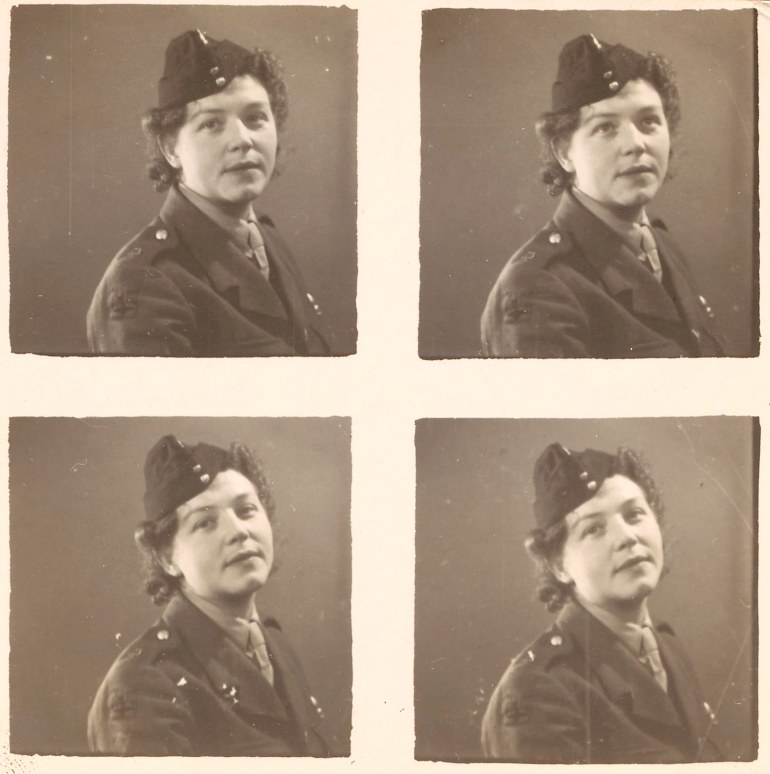
In the first part of this blog, I will be providing the all-important context behind the ATS and what other treasures can be found in our archive. Then in part two, I will be delving into the background of Mary Chapman herself and at this stage I am awaiting to see whether I can receive her military records from the MOD. However, her record is currently closed under the Freedom of Information Act 2000 and will need to be sensitivity reviewed before the MOD can determine whether it is possible to open it to the public. Either way in a few months’ time I will be writing the second part on what I find out about Mary Chapman.
What was the ATS?
The origins of the ATS stem from the women who served in WW1 in the Women’s Army Auxiliary Corps (WAAC), which was formed in 1917 to allow for more men to fight in the war efforts. It was at first believed that women were not suited to military work, other than nursing. However, these beliefs had to be challenged when the Department of National Service needed to call up more men for frontline service. Although challenged their beliefs were, they were not turned on their heads! Women were given ‘feminine-coded’ jobs within the auxiliary service. For example, “store work, administration and catering”.
In 1918 Queen Mary became the patron, and the service was renamed Queen Mary’s Army Auxiliary Corps (QMAAC). And they were no longer confined just to service in Britain, as they were drafted to France. Despite being restricted to support roles, the women of the QMAAC still faced danger. “Overall, 81 women of the QMAAC were killed, and five were awarded the Military Medal for their services.”
This unit was eventually disbanded in 1921 but the legacy lived on as in September 1938 the ATS was formed under a new threat of war.
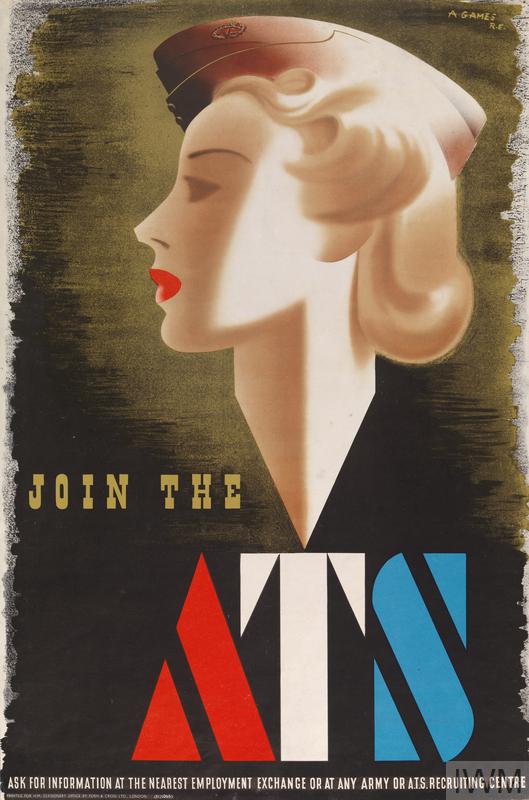
Previously, the women in the QMAAC were volunteers, but from April 1941, those in the ATS were granted full military service, although women were still not allowed to be in combat roles. With the continuing growing need to defend and protect Britain, conscription extended to women in December 1941.
The roles that women could take on in the ATS were at first limited, similar to the QMAAC, and they were once again ‘feminine’ coded. However, as more men were needed on the frontlines, the roles in the ATS began to expand into the stereotypical male roles. “By 1943, about 56,000 women were serving with anti-aircraft units, although they were still not allowed to fire the guns. Women were also now allowed to serve in all theatres of war with the ATS.”
Following the end of the war in 1945, women had more than proven that they were an asset to the British Army and could no longer be viewed just as an “emergency measure”. Furthermore, women in the ATS picked up invaluable skills that could serve them in future careers. This includes, but is not limited to, banking and nursing.
The ATS was not disbanded but rather became part of the Women’s Royal Army Corps (WRAC), which was a permanent unit of the army until 1992; by this time many of the women serving in the WRAC had been transferred to different units. However, all roles within the army were not actually opened up to all women until 2018, and even though it took decades after WWII for this to happen, the impact of the ATS ripples through time.
With thanks to the National Army Museum for information on the QMAAC and the ATS.
What is in our archive?
Below I have complied a list of items and collections that relate to the ATS from our archive:
- AM 24
- AM 299
- AM 636/1
- AM 775/A/2/5
- Garland N18500
- Garland N18501
- Garland N18502
- Garland N18503-18505
- Garland N20013
- Garland N21746
- Garland N22118-22120
- Garland N22314
- Garland N22315
- Garland N22316
- Garland N22317
- Garland N22588-22592
- Garland N23254
- Garland N24123
- Garland N24124
- MP 3730
- MP 7379
- MP 8808/2/1
- MP 8817/1/1
- PH 32001/21-22
- SEREC (Southern England Railway Employee Cards): Audrey Mary Keen, Kathleen Dorothy Newman, Doris Winifred Simmons and Evelyn Wilkes
Keep your eyes peeled for the second part of this blog where I will be sharing what I find out about Mary Chapman and her service in WWII. Her photograph album sheds a wonderfully warm and bright light on patches of her life during the war, but I hope through research we can shed just a little bit more light on Mary. I also hope to add this extra detail to our catalogue for future researchers to discover.
Stay up to date with WSRO – follow us on Facebook, Instagram, Threads and YouTube

 West Sussex Record Office
Among several women on the war memorial in Rudgwick, whose names I have ben researching recently, is Private Joan Mary Clevett, aged just 16, who died at Tidworth Camp, Wiltshire on 6 January 1942. By some margin, she was the youngest of either sex from Rudgwick to die in the war, I have no idea why she was at Tidworth at so young an age, or what caused her death. Sadly her family also lost her brother later in the war. She was just one of only two ATS women to die at Tidworth. Her links to W Sussex are tenuous as her mother, a widow, had only recently moved to lodgings in Rudgwick from East Sussex.
LikeLike