By Jenny Bettger, Archives Assistant (Research)
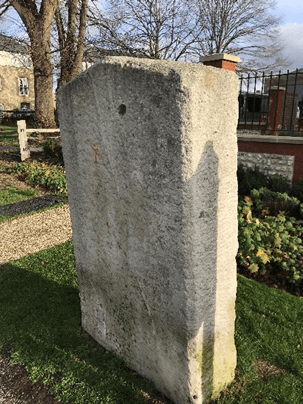
Walking along Broyle Road in Chichester you will find a large stone with a faded inscription. Known as ‘The Smugglers Stone’, it records the execution of six members of the notorious Hawkhurst Gang in 1749. From their base in Kent, this gang controlled much of the smuggling trade along the south coast to Dorset. Following a brazen attack on the customs house at Poole in Dorset, the authorities were determined to break up this dangerous gang. But it was events and the subsequent trial that occurred in West Sussex that helped bring about their downfall.
Records in our archives give an insight into the violence used by the smugglers and the number of people involved in the activity. Many of these documents are in a collection of papers belonging to the 2nd Duke of Richmond (Goodwood Mss 154 and 155), who was instrumental in bringing those responsible to justice. A report containing lurid and sensational details published shortly after the trial also provides an insight into the characters of those involved in the crime (Lib 12392).
In February 1748, customs officer William Galley and Daniel Chater, a witness travelling to Chichester to give evidence against the gang disappeared. Due to the fear of reprisals, few people spoke out against the smugglers. A letter to the Duke shows the concern over what may have occurred:
[That] in sending the informer to Chichester under the Care of an officer of this Port they were both mett with upon the Road or have Carry’d off or Murdered by some of that Gang
6 February 1747 [1748 modern dating] (Goodwood Mss 155, folio H8)
It was some time before the fate of the pair was known, but it was later confirmed that they had been kidnapped by the gang and subsequently murdered. According to the report written following the trial, the pair had stopped for directions at a pub in Rowlands Castle which was used by members of the gang. They were first subdued with alcohol while the gang decided how to proceed, with one suggesting:
[To] take them both to a well, a little way from the house, and to murder them and throw them in.
Lib 12392
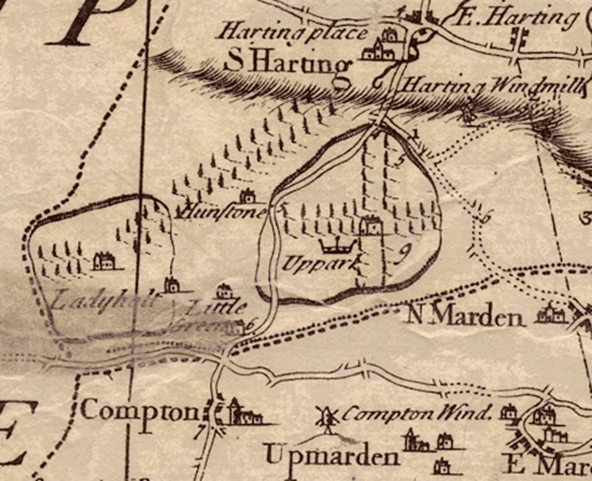
Instead, they decided to take Galley and Chater captive and confine them to prevent the pair testifying against the gang. Beaten and tied to horses, they were then taken on a meandering journey, passing through Lady Holt Park and over Harting Down. Turned away by one smuggling associate, they finally reached the Red Lion pub at Rake on the Sussex, Hampshire border at around one or two in the morning. This pub was located next to the main Portsmouth to London Road, backing onto the sparsely populated Harting Common, a convenient base for smuggling.
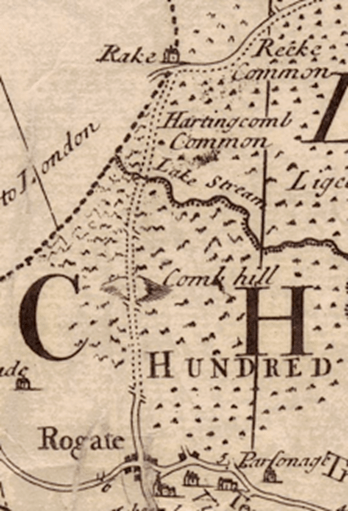
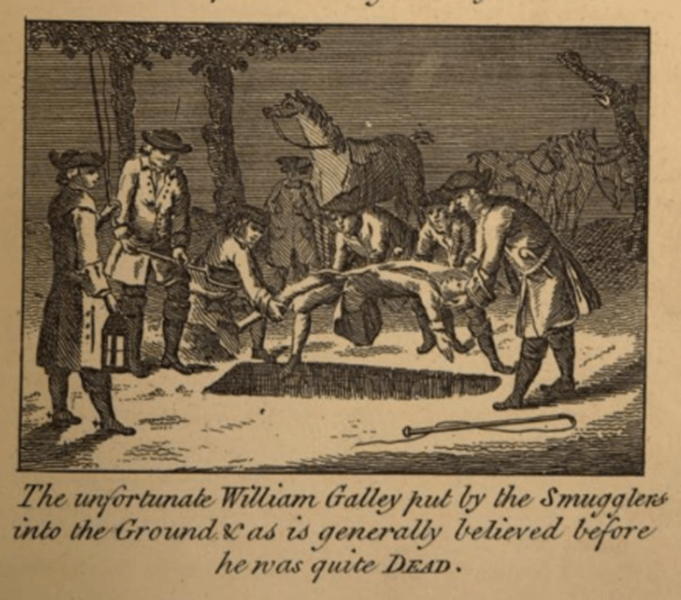
After their arrival, the group left the two captives in a brewhouse attached to the pub while they celebrated their good fortune. Sometime later the landlord found the customs agent, William Galley, dead or near dead. He assisted the group in conveying Galley’s body to a secluded spot near Rogate, where they buried him in a fox earth. The sensational writing in the account suggests he may have been buried alive. Due to the notoriety of the crime, this area became known as Galley Grove.
According to the reports, Daniel Chater was held for several more days in a storehouse nearby belonging to the elder Richard Mills. He and his sons Richard (the younger) and John, as well as other local associates, joined the gang in deciding what to do next. Unfortunately, Chater’s willingness to assist the authorities had already sealed his fate and, after much discussion, the gang decided to murder him. He was taken to Lady Holt Park on the border with Hampshire, where they attempted to hang him by tying a rope to a fence surrounding an open well and then pushing him down. In a tragic sequence of events, the rope was too short to accomplish this and when they threw him down without the rope, the fall was not deep enough to kill him. After several other failed attempts, the gang finally succeeded in killing Chater.
It was sometime before the authorities managed to discover the fate of William Galley and Daniel Chater and locate where they were buried. Papers from the 2nd Duke of Richmond (Goodwood Mss 155) include payments of over £20 for 50 soldiers sent to search for their bodies. Galley’s body was discovered on 15th September 1748 and Chater’s two days later. An entry in the Rogate parish register shows that Galley was reburied in the churchyard, but no record was found for Chater.

In order to bring the main perpetrators to justice, pardons or leniency were offered to those members of the gang who agreed to testify against them. William Scardefield, the landlord of the Red Lion at Rake, who had harboured the gang and helped to bury Galley’s body, was one of those. A document in the Goodwood papers shows the fear the gang inspired in another witness called Hollier:
[If] they hear of my being in a publick gaol, and that any particular people come after me it will give them a suspicion, and then they may burn my house and murder my family. For there is nothing ever so cruel or desperate which they are not reddy to attempt or execute as far as they are able.
Letter 28/10/1748 (Goodwood Mss 155, folio H16)
The documents and accounts of the case include a lengthy list of the smugglers involved in different parts of the crimes against Galley and Chater. The gang members were often referred to by nicknames or aliases, making them more difficult to identify. A recent addition to the Record Office archives is an extensive guide to Kent and Sussex Smugglers 1715-1750 (MP 9085), which includes research on over 750 named smugglers operating during that short time.
The seven men who were finally brought to trial in 1749 were:
- William Carter of Rowlands Castle, aged 39
- John Cobby of Sidlesham, aged 30
- John Hammond of Bersted, aged 40
- William Jackson of Aldsworth, aged 50
- Richard Mills the elder of Trotton, aged 68
- Richard Mills the younger of Stedham, aged 37
- Benjamin Tapner of West Stoke, aged 27
All the men were convicted and sentenced to death. However, William Jackson died before the sentence could be carried out. The remaining six men were all hanged together on the Broyle on the 19th January 1749. Following the execution, their bodies were displayed in gibbets at Rook’s Hill near Chichester, Rake and Selsey as a warning to others. Richard Mills’ other son, John or ‘Smoaker’, had evaded the authorities but was later tried and executed for his involvement in the murder of Richard Hawkins at Parham. Over the next few years, authorities continued their efforts to round up other members of the Hawkhurst Gang. Although they were successful with this gang smuggling would continue to be a problem. You can read more about our smuggling records here.
Stay up to date with WSRO – follow us on Facebook, Instagram, Threads, Bluesky and YouTube

 West Sussex Record Office