By Nick Corbo-Stewart, Archivist
Travelling back to 1975 the United Kingdom had a very different feel, a population of just over 56 million people, coal fired power stations generating electricity, weekly cash salaries, white sliced bread, families with one car, three TV channels, Tom Baker as Dr Who, flares, Leeds United in the European Cup final, record sales of Bohemian Rhapsody, no mobile phones/devices or the internet. Politically, as a nation, we were led by Queen Elizabeth II as Head of State, Harold Wilson as Prime Minister, and we had just joined as a full member of the European Economic Community (EEC), whilst being active within the Council of Europe (CoE).
It was this year the CoE designated as European Architectural Heritage Year (EAHY). In the UK, a central committee was established to encourage and awaken interest in architectural heritage through a series of conservation and improvement projects. The challenge was taken up by West Sussex Record Office (WSRO) as an opportunity to use the help of the local community and conduct a photographic survey of towns and villages across the county. The idea was for the survey to provide a unique snapshot of the county and was particularly timely as just the previous year, 1974, West Sussex had been established as a ceremonial county. The project would take advantage of the fact that many people had 35mm film cameras. An impressive 102 groups/individuals offered to participate, and surveys were promised across 101 communities.
The surveys were to be conducted by parish. The participants were provided with black and white 35mm films, record sheets and copies of Ordnance Survey (OS) maps. They then took a series of photographs of all buildings of interest within that parish, recording them on the survey sheet and indicating the location on an OS map.
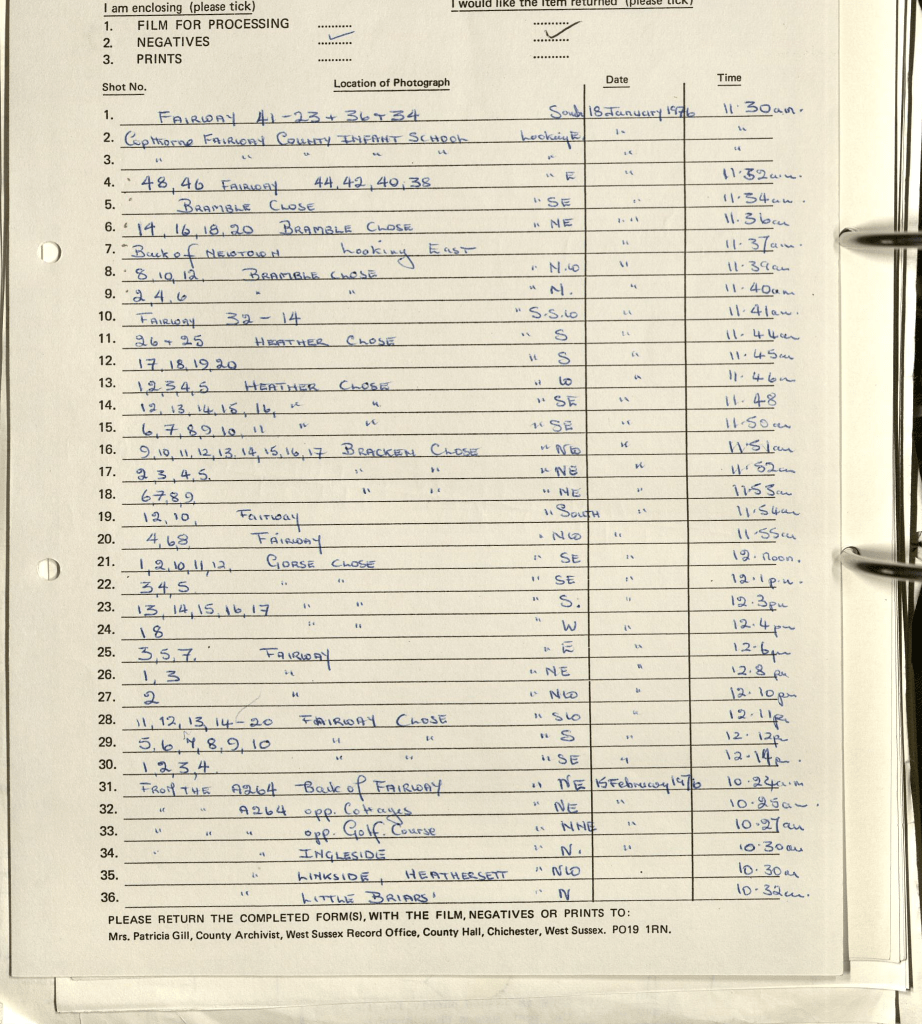
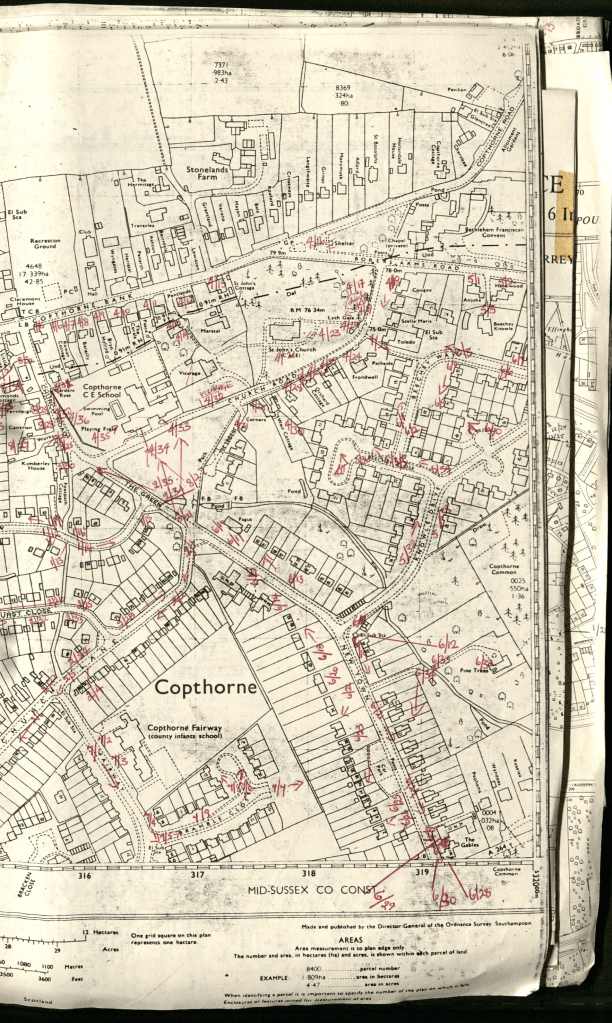
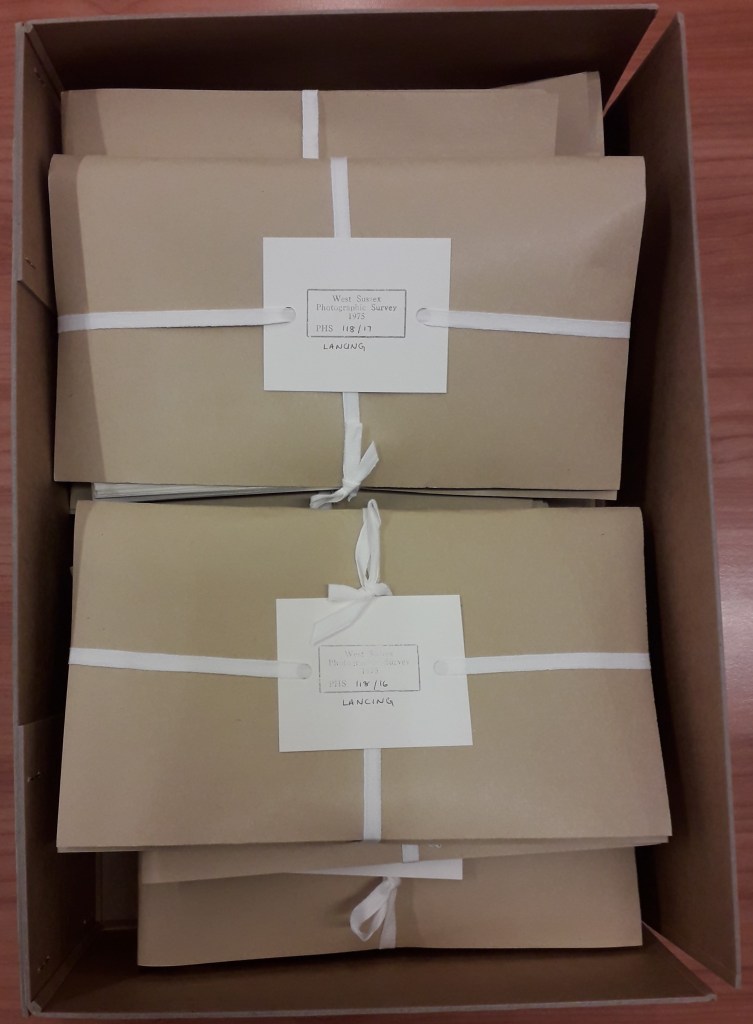
By the beginning of 1976, contributions had been received from 53 groups and individuals, comprising a total of 286 films. The rolls of films and documentation were then deposited with the Record Office for preservation and future access. In the majority of cases, the Record Office, rather than the original photographers, made photographic prints from the negatives. This has resulted in the production of over 8500 photographs where were allocated the collection reference ‘PHS’.
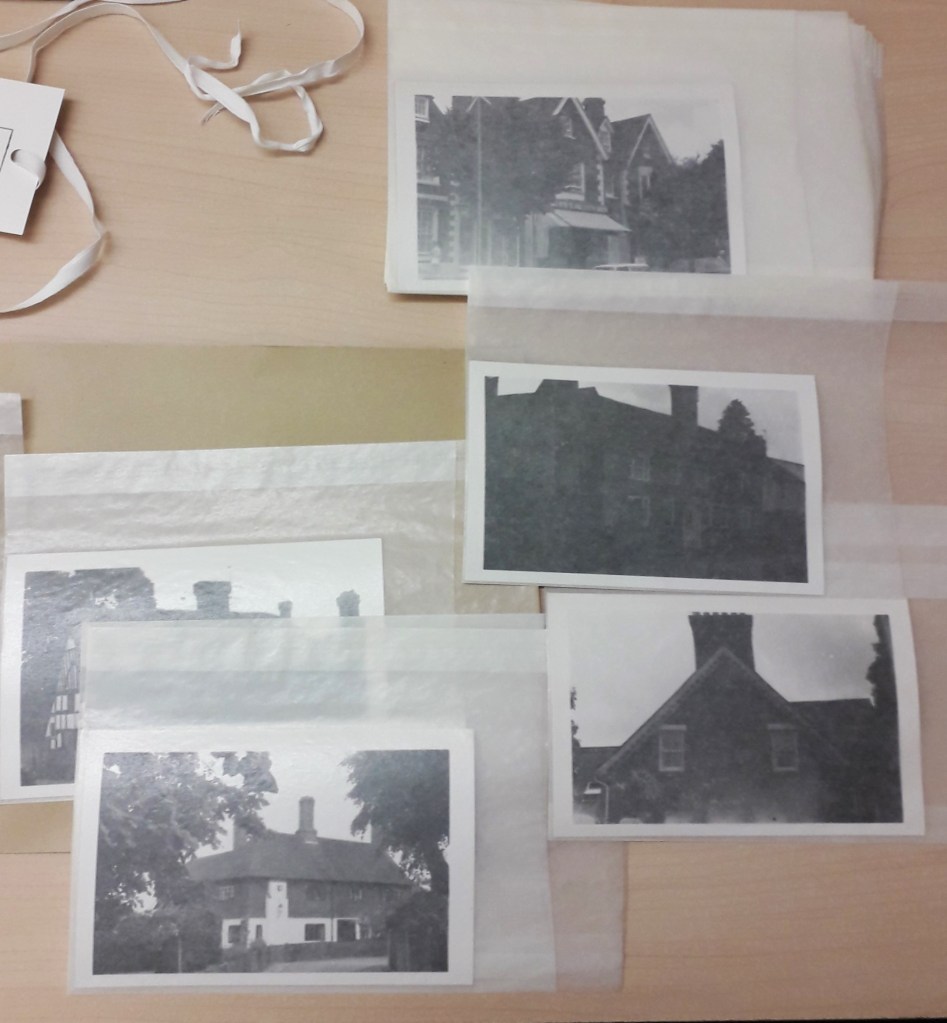
For the researcher, these photographs present a unique visual architectural tour of the county taking in towns, villages, hamlets, factories, farms and country houses and providing an amazing panorama of West Sussex in the mid-1970s. It is a collection of contrasts, old versus new, preserving images of buildings unchanged or presenting forthright modernist development. A lot of the photographs show that many aspects of rural life remained unchanged. Roads, often empty or with little traffic, ‘finger post’ road signs, public houses with painted signage, corner shops, quaint cottages, village ponds and Saxon/Norman churches. Other photographs show the new developments such as post-war housing estates, American influenced shopping centres, industrial units, line painted roads, spacious schools, open plan offices and administrative buildings. Together, these images present a snapshot of a rapidly changing county as urban post-war development continued apace. If you want to see what West Sussex actually looked like in the later 20th century, this collection presents it as a visual panorama.
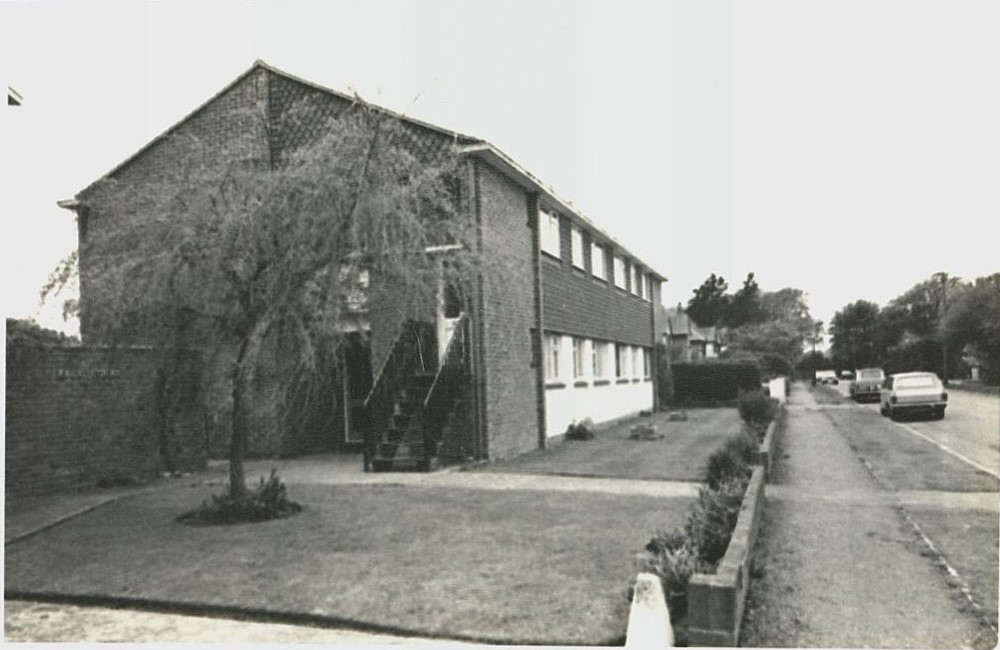
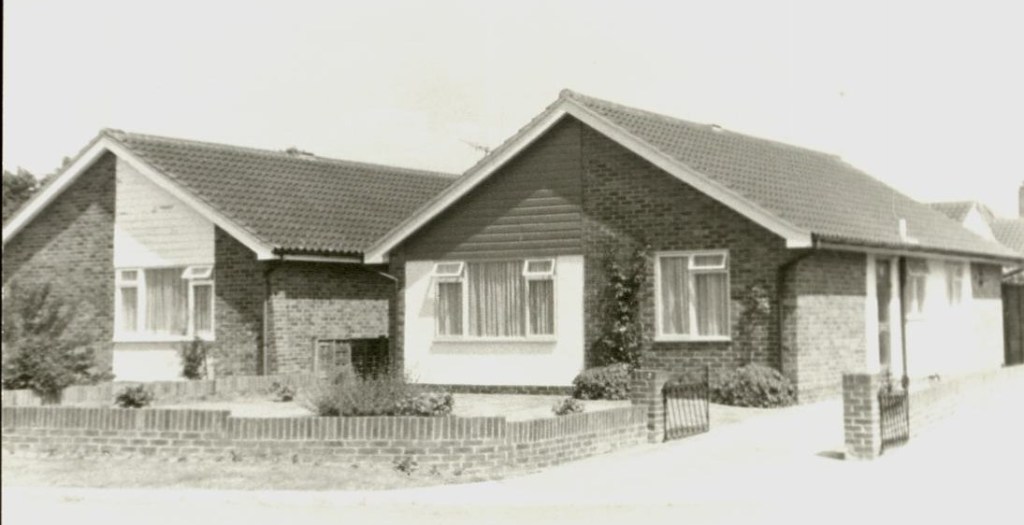
2025 marks fifty years since the Record Office begun this unique survey of its County’s architecture. So how accessible is this collection now? Although the photographs are well protected, numbered and easily producible, the only finding aid was the original paper based catalogue which had become fragile and difficult to use; it was also not possible for researchers to find relevant records via the online catalogue. The collection was closed to public access. So, at the beginning of 2020, a project was undertaken to convert the paper lists into a new digital catalogue. The first stage of this project was to transcribe and arrange the lists into spreadsheets. This hard work was done by WSRO’s volunteers.
The second stage of the project, which requires checking and preparing the lists for uploading, has begun. This takes time and effort of the archivists involved but a new digital catalogue is gradually emerging for the collection. So far, nearly 3000 descriptions of the images in this collection have been uploaded to our online catalogue, with more to come. WSRO will soon be allowing access to these, so please watch out for further updates. 50 years on, the 1970s are coming back!
Stay up to date with WSRO – follow us on Facebook, Instagram, Threads, Bluesky and YouTube

 West Sussex Record Office