By Louise Conway, Archives Assistant
Part 1 of the Shoreham Bungalow Town blog introduced the area and it’s developments (read it here), this blog focuses on how this small area became, for a small time, ‘the Los Angeles of British productions’.
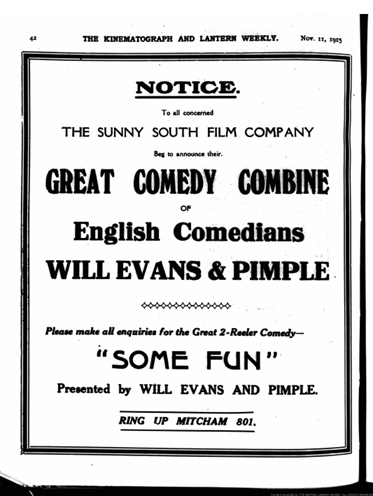
Sunny South Film Company 1914 – 1915
The first film company in Shoreham was Sunny South Films, a partnership between F. L. Lyndhurst and Will Evans. Francis Leonard Lyndhurst (1878 – 1952) had a successful career as a scenic artist when he and his wife Dorothy built their Bungalow Town dwelling ‘Lyndora’.
Will Evans (1866 – 1931), was a successful sketch comedian, building bungalows, ‘Hop O’My Thumb’, ‘The Baroness’, ‘Puss in Boots’, ‘Sleeping Beauty’ and ‘The Swallow’ each named after characters he’d played or shows he’d been in.
Using the then abandoned Old Fort, they filmed in the open air, with simple backdrops.
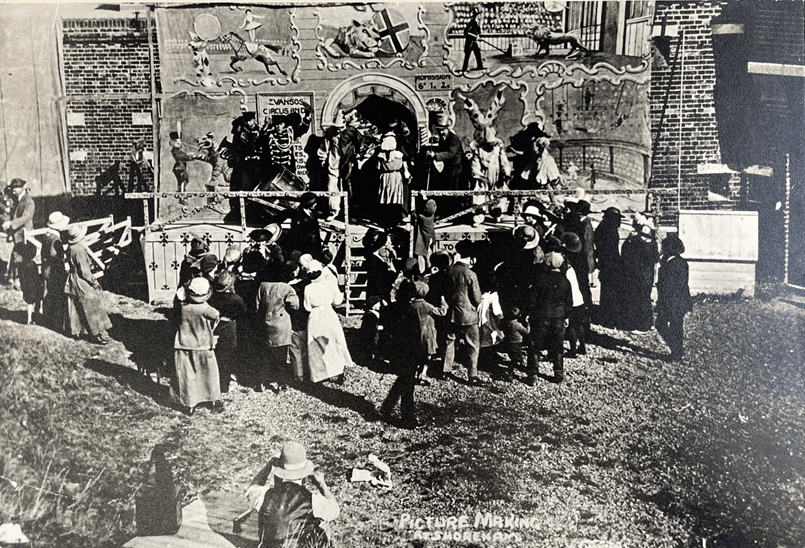
The content initially comprised of recreations of some of the most popular music hall sketches of the time along with their own new sketches. Their ventures were successful, but quickly the motion picture business began to evolve.
Sealight Film Company – 1915
At a new site the other end of the beach, F. L. Lyndhurst founded Sealight Film Company and commissioned the building of a glasshouse studio.
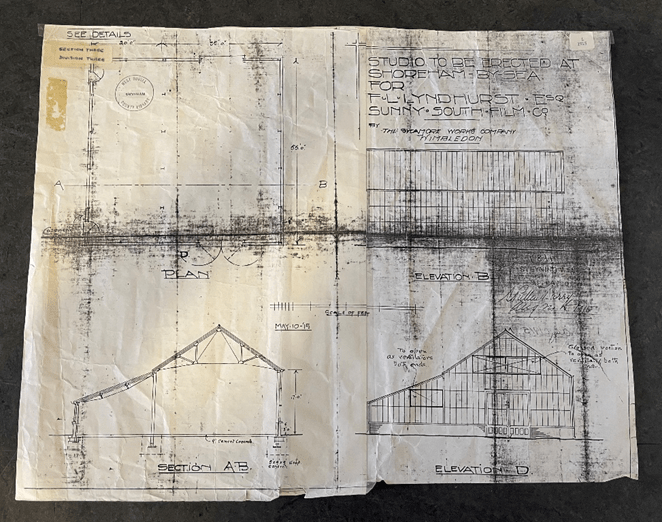
However, Lyndhurst only directed one film here before selling the studio to Olympic Kine Trading Company. Under this new ownership, there is no evidence that any filming took place.
Progress Film Company – 1919 – 1922
Filming in Shoreham resumed once the Manchester-based Progress Film Company took the glasshouse studio over in the summer 1919.
The company prospectus praised Shoreham and its favourable film production qualities; “the climatic conditions of Shoreham-by-Sea are particularly suitable, and peculiarly adapted for daylight production. The air is wonderfully clear, and quite free from fogs, and as the studio is situated on a spot at least 50 miles from any real smoke, a pure and clean light may be obtained, probably unrivalled by any other place in England. Undoubtedly the Los Angeles of English production”
Under writer / director Sidney Morgan, Progress Film Company become renowned for their ambitious adaptations of famous novels into films. One of the few surviving examples of their productions is Charles Dickens’ ‘Little Dorrit’. A later 9.5mm compressed version of the film (made for the Pathéscope Home Cinema market) survives and has been digitised, available to view on Screen Archive South East’s website.
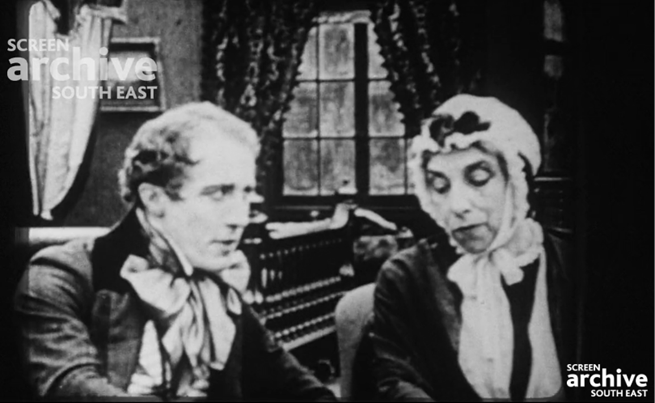
Progress Film Company was very successful in its early years and soon developed their site, building a yard for building large sets and later an editing suite, preview theatre and small laboratory for processing film.
Over four years, they made an impressive 17 films thanks to a schedule of spending the summer months filming and the winter months planning and editing.
The studio survived longer than many British studios, largely due to relatively low production costs – artists and technicians could live in ‘Studio Rest’, extras were cheap and easy to obtain and this lifestyle of living on the job, mirrored that of Hollywood, albeit on a smaller scale.
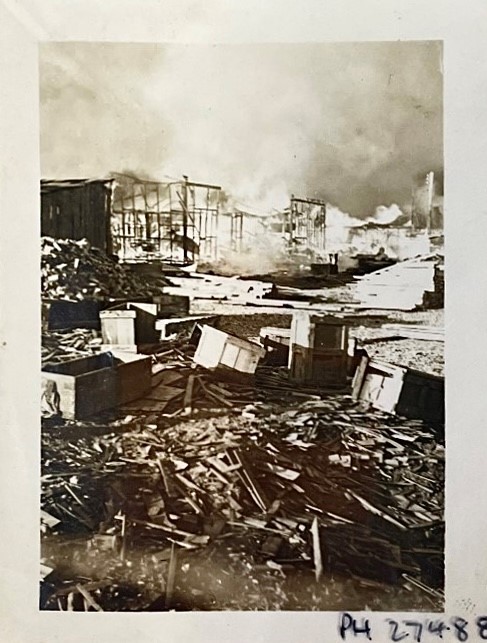
As many studios began to embrace electrical lighting, Progress’ studio was one of the last glasshouse film studios still in operation in the UK. However, in December 1922 a fire broke out across the site destroying a number of bungalows and other buildings, the main studio was also damaged. Simultaneously, Sidney Morgan as his family made the decision to move on from Shoreham, and competition from US studios was really stepping up, subsequently, Progress Film Company pulled out of Shoreham.
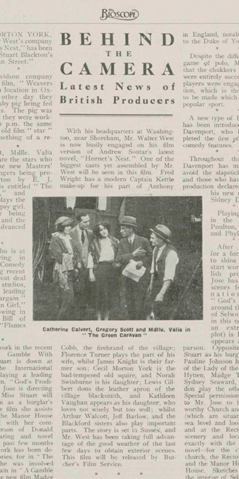
This was not the complete end for filmmaking in Shoreham, as the site was used by Walter West and then The Carlton Film Company. However, their outputs were minimal and soon film production in Bungalow Town came to an end.
Stay up to date with WSRO – follow us on Facebook, Instagram, Threads, Bluesky and YouTube

 West Sussex Record Office
How interesting. Such details here, really brings this unusually early time of film making in this uniquely suitable location to life .
Such a shame about the fire. What more they might have achieved we shall never know.
Alongside the creativity of early aviation at the Shoreham airfield, this was an interesting place to be !
LikeLiked by 1 person