By Jenny Bettger, Archives Assistant (Research)
Workhouse records can give an insight into the lives and struggles of the poorest members of the population. In the admission and discharge registers, you will often find the same names popping up with surprising regularity. From the brief descriptions of their reasons for entering or leaving, you can get a sense of the struggles they endured and come to understand their character. This blog will be looking at the experiences of Josiah Glue from Rogate, who entered the Midhurst Union Workhouse as a child.

Josiah first appears in the workhouse records being admitted on his own in February 1836, aged 7. He was the only child of Joseph and Hannah Glue, his father had been transported for various crimes in 1834, and his mother had died the following year, leaving Josiah an orphan. Although there was a large extended family living in the area, they did not appear to have the resources to care for him and the local parish then became responsible for their maintenance. It is possible that Josiah remained in contact with members of his family, with many also spending time in the workhouse over the same period.
Up to 1834, Rogate had operated a small parish workhouse, but in 1835, with other local parishes, it became part of the Midhurst Union. The much larger workhouse located at Budgenor Lodge in Easebourne could hold around 300 inmates. There were separate sections for men, women and children, with strict rules and harsh discipline. A regulation from 1837 ‘forbade the boys entering the buildings during the day except for meals, lessons or special purposes’ (Lib 18316). Adults who were able were made to undertake laborious tasks. The food that the inmates received depended on the age and sex, with meat only provided three days a week.


Josiah does not appear in the records again until April 1841 when aged 14, the census shows him among the occupants of the workhouse. In July just a few the discharge register states that he had absconded with the union clothes. Although it does not give a reason for his leaving, Josiah is unlikely to have had any other clothes than the ones provided by the workhouse.
Leaving whilst wearing clothes belonging to the workhouse was an offence and after he absconded again the following year he was prosecuted. Court records from 1842 give details of the clothes he was wearing:
[Josiah Glue] did on Tuesday the sixth day of September instant desert and run away from the said Union Workhouse and carry away with him divers Clothes (to wit) one jacket, one waistcoat, one pair of Trowsers, one shirt, one pair of shoes and a cap, the property of the Guardians of the poor of the Midhurst Union
[QR/W806/346]
Josiah’s time spent out of the workhouse was brief, and he was readmitted less than a week later, with the reason given as ‘fatherless and no home’. This was just the beginning of a pattern that would continue for much of his life, moving between the workhouse and prison. Between 1843 and 1847 Josiah was admitted and then discharged from Midhurst Workhouse on over 20 occasions. His reasons for discharge were often given at his own request, but there were also several entries where he absconded or was committed to prison. In 1843, aged 15, he was sent to prison for a month for breaking a window at the workhouse and in 1846 he was convicted again for taking clothes from the union, this time receiving three months hard labour.
The registers give little clue to where Josiah went during his frequent absences. He is likely to have picked up casual work as a labourer, which was given as his occupation once he reached the age of 16. One entry in 1845 states he had left to go to sea. However, this does not seem to have lasted as he was back only a few months later. His time out of the workhouse was often brief, from a few days to a few months at a time. However, between 1847 and 1852 he disappears from the Midhurst registers. Military records show that, aged 17, he had joined the 17th Regiment of Foot, where he served for over a year in India. The army would have provided a steady income and a way to escape the cycle of poverty he was trapped in. Unfortunately, although the discipline may have been familiar from his upbringing, his time in the army does not appear to have reformed his behaviour. His conduct was described as very bad. He received a court-martial for attacking a corporal in 1849 and only escaped another due to his medical discharge the following year.
After his return to the area, Josiah resumed his frequent stays in the workhouse. He continued to struggle with the regime and they with his increasingly troubling behaviour, and in 1853, after entering due to destitution in February, he conducted a dramatic nighttime escape. The registers usually briefly go into detail of how, on the night of the 6th of March, he escaped by tying sheets together and then climbing down on to the roof of the boardroom. From there he fell into the yard and made off carrying various articles of bedding. It also references the Offences Book, suggesting that there was further information recorded. Sadly, this record has not survived.
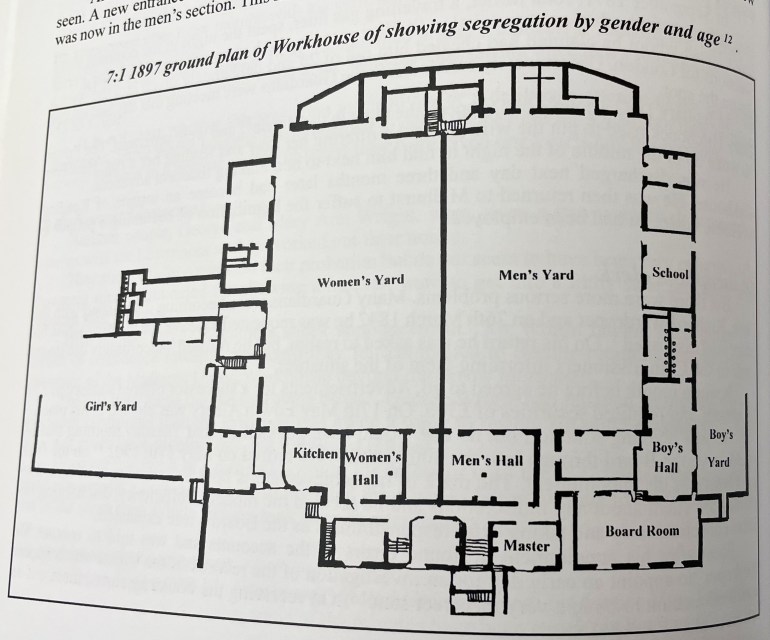
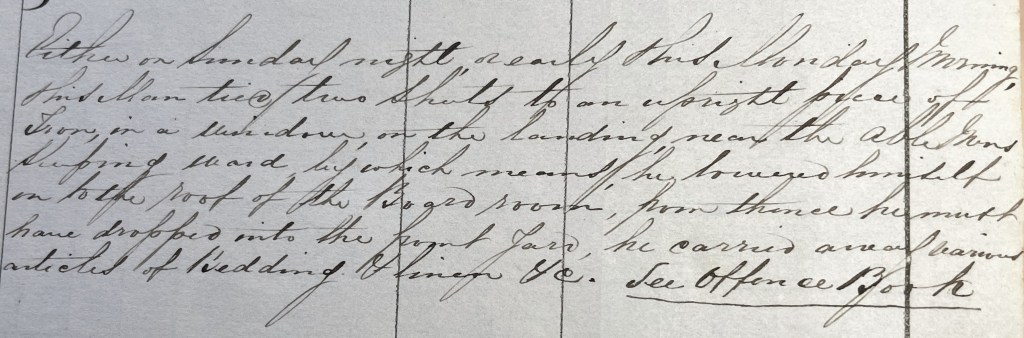
Newspaper reports give further details with The Sussex Advertiser (15th March 1853) describing it as a ‘daring escape’ with the climb being 40 to 50 feet. It was also reported that he had previously been given money and clothes by authorities promising to leave the country and redeem his character. Instead, he pawned the clothes and spent the money. Unfortunately, Josiah continued to get into trouble in the years following and was repeatedly convicted, often under aliases, making him difficult to trace. Eventually, he was transported to Australia in 1861, aged 33, but only after he made a plea from prison asking to be sent. He may have hoped to have met up with his father and other relatives, but sadly, he was sent to Western Australia, the other side of the country. From there he disappears from the records. I hope that he finally managed to live a life outside the confines of the workhouse and prison.
The collection of poor law records for the Midhurst Union can be found under reference PL/WG7. A history of the Midhurst Workhouse Union and the earlier Easebourne Union is available to view at the Record Office (Lib 18316). For more information on the history of workhouses and poor law see this website: https://www.workhouses.org.uk/.
Stay up to date with WSRO – follow us on Facebook, Instagram, Threads, Bluesky and YouTube

 West Sussex Record Office