By Lois Bodie, Archives Assistant
You can learn a great deal about a place and its history by focusing on one particular point and charting its change. For me, I have grown increasingly interested in the history of St Martin’s Street in Chichester, only a minute or two by foot from the medieval Market Cross. As unassuming as it might first appear, this street alone has seen much of the city’s change over the centuries. Tucked in the shadow of both North Street and East Street, today it sees a steady stream of people making their way from the Crooked S alley on their way to Marks & Spencer, the pub The Hole in the Wall and Splits Bakery – but it wasn’t always the pleasant smell of sweet treats that lingered in the air.
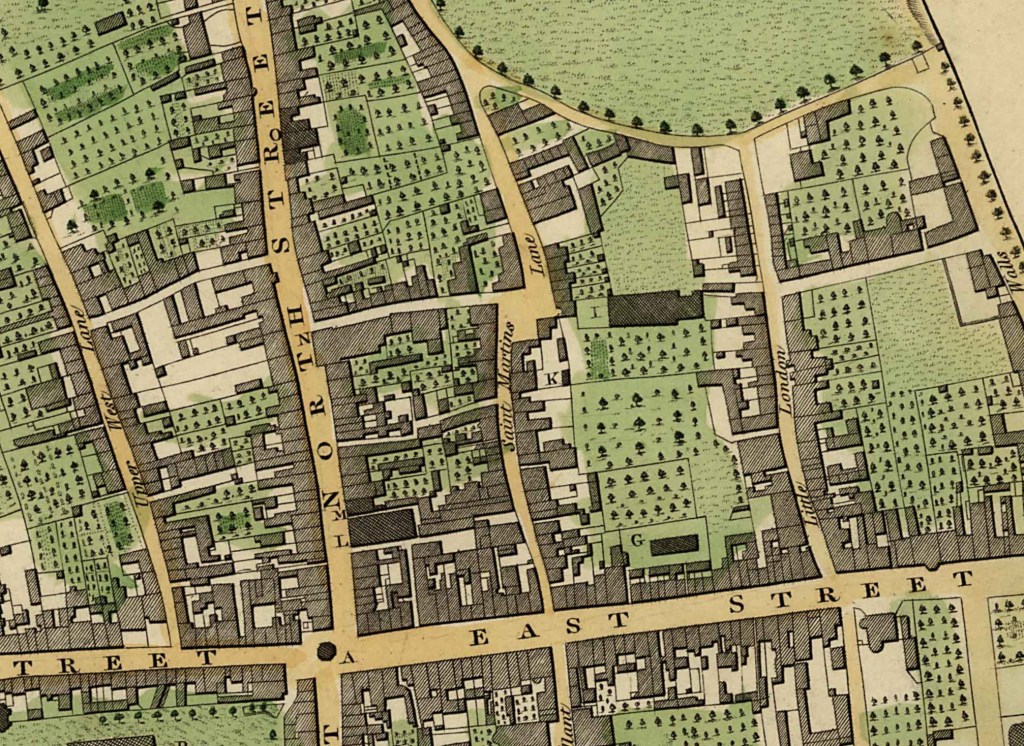
Hog Lane
Chichester has deep Roman roots, as is well known, but my research into St Martin’s Street begins in the medieval period. By this time, Chichester had grown into a thriving market town and this market largely took place in St Martin’s Street, or, as it was known then, Hog Lane. Chichester’s ‘beast market’, held every second Wednesday, enabled the trade of livestock, with different parts of North, East and St Martin’s Streets sectioned off for the sale of various farm animals – it isn’t too hard to imagine exactly what was bought and sold in Hog Lane. On market days, Chichester would have been awash with people and animals, and the local taverns would likely have seen a roaring trade too. By the 13th century, the city’s population is estimated to have been around 2,500, and this number would likely have doubled as farmers and people from neighbouring towns, Portsmouth for one, came to buy and sell produce (Lib 18303). The site currently occupied by 21 St Martin’s Square was once the corporation animal pound, presumably for holding pigs that tried to stray from the market (Lib 16025).
However, the filth and stench eventually became too much after centuries of trade, so in 1871 the beast market was moved just outside of the city walls, to where the Cattle Market car park now sits. It remained a regular event in its new location until 1990, when it became too impractical to bring large numbers of animals into the city, thus concluding hundreds of years of livestock trade in Chichester.
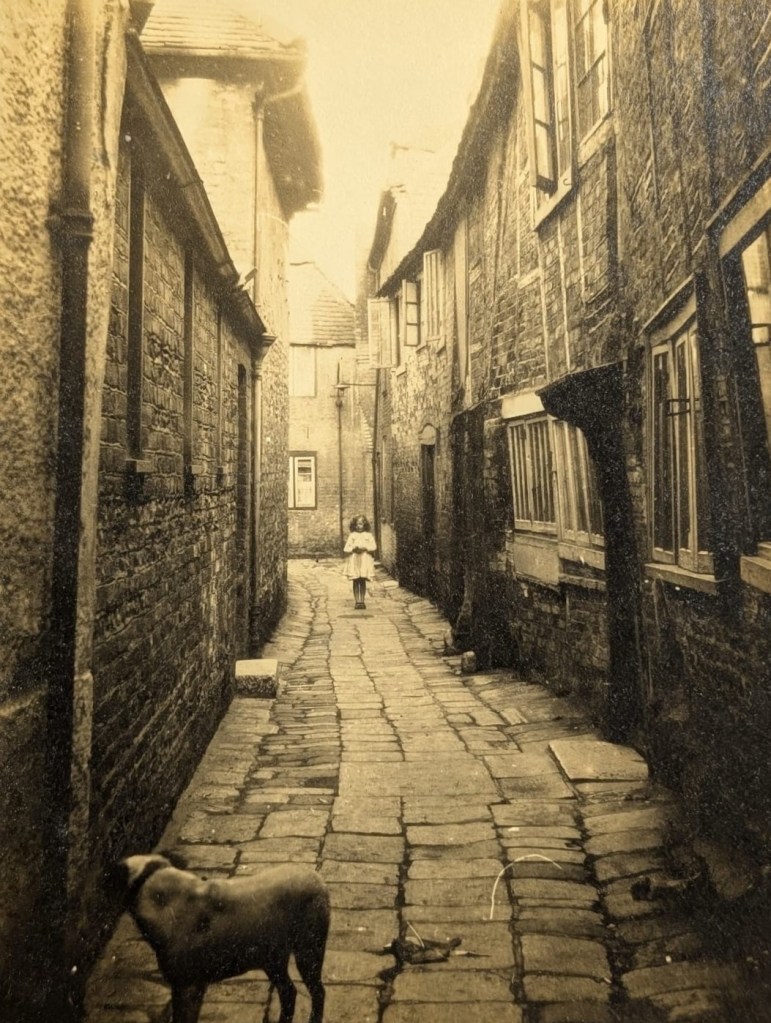
The Shambles
As well as the pig market, this area also contained the city’s slaughterhouses: the Crooked S was once known as the Shambles, or Shambles Alley, and it stretched back a lot further than it does now. We can only imagine how heavy the air was with the smell of raw meat and salt, particularly on a hot summer’s day, and the constant drone of flies, for the offal would inevitably have been thrown out into the street.

‘St Martin in the Pigmarket’
Pigs and butchery aside, this street was also home to St Martin’s Church, now a ruin which has been returned to nature. It started to fall into disrepair in the 18th century, was eventually declared a danger to the public in 1903 and pulled down in 1906 (Par 41/4/3). The earliest surviving mention of St Martin’s Church comes from 1260, when it was referred to as ‘St Martin in the Pigmarket’, proving just how far back Chichester’s livestock trade reaches. The parish registers for St Martin’s, held here at the Record Office, date from 1561 and detail the baptisms, marriages and burials of the local populace. It is sad, yet peaceful, to sit in the ruined church now and imagine all the people that once walked through its doors, marking the major moments of their lives that we can still see the proof of today.

This entry reads: Richard Symes and Elizabeth Braman, widow, both of the city of Chichester, were married the 26th day of February 1681 in St Martin’s Church.
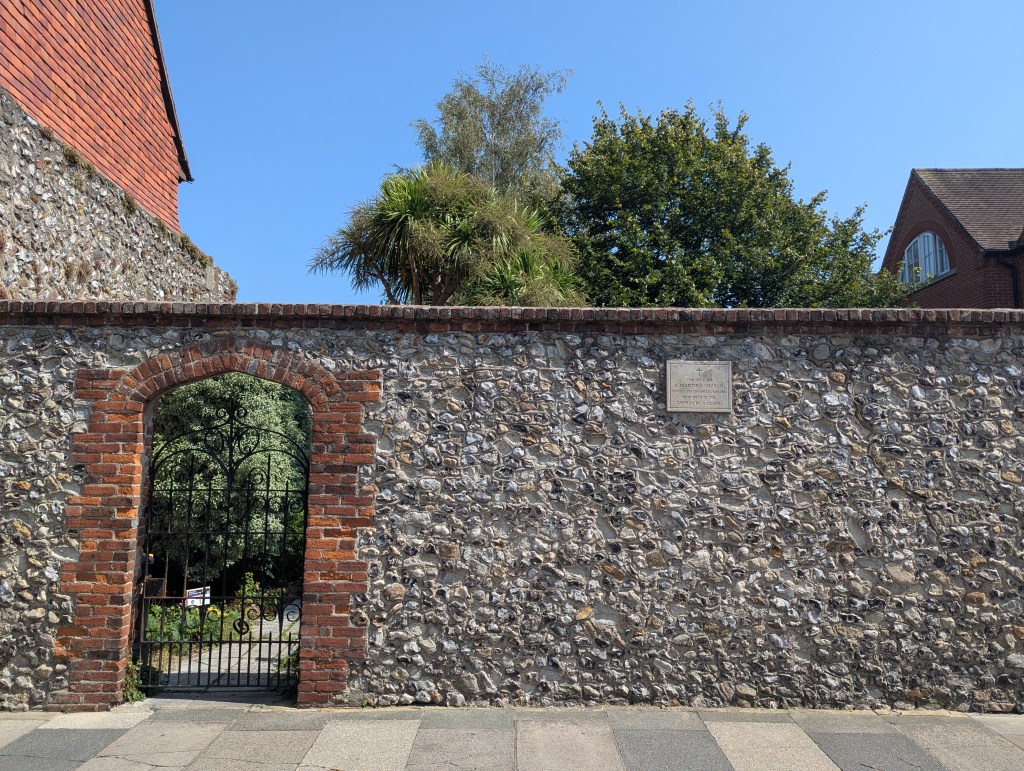
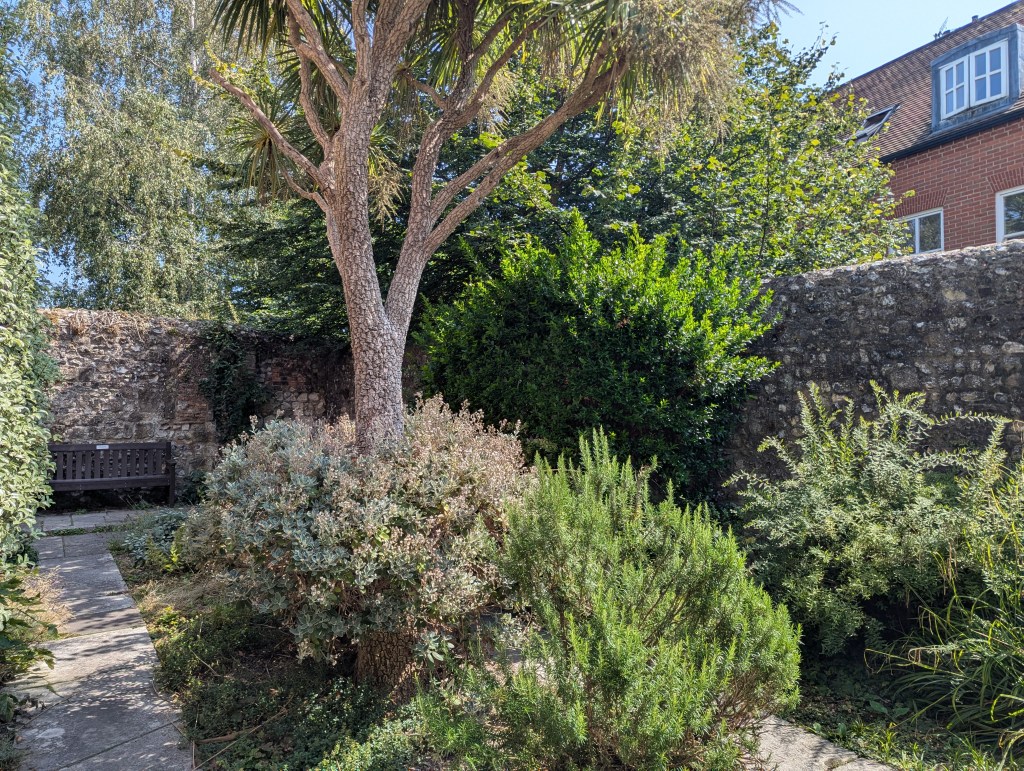
Photographs of St Martin’s Church as it is today (taken by Lois Bodie)
St Mary’s Hospital and Almshouses
Another important building that cannot go unmentioned is St Mary’s Hospital and Almhouses. Now part of St Martin’s Square rather than Street (the Square was once part of St Martin’s Street, which stretched the entire way from East Street to Priory Lane and only acquired its separate identity by 1820), St Mary’s has existed on this site for almost 800 years. It is a remarkable surviving example of a 13th century hospital. It is still in use today, providing home and care for a number of elderly residents, but it once cared for the sick and poor as well as provided shelter to pilgrims and other travellers. During the time of the Reformation and dissolution of the monasteries, many hospitals across the country also found themselves dissolved due to the fact that monasteries were the main care providers, though fortunately St Mary’s remained untouched; and perhaps more surprisingly, when William Waller’s soldiers sacked Chichester Cathedral during the English Civil War, and later when a German aircraft bombed St Martin’s Street, St Mary’s again escaped ruin (although it did suffer some damage in the case of the latter), allowing it to survive into the 21st century and provide us with a unique glimpse into a time gone by (Lib 18303).
Georgian Era
However, Chichester gained most of its recognisable character in the Georgian era (1714–1837). One of the city’s best-preserved streets showcasing Georgian architecture is St Martin’s Square, with its sash windows, elegant doorways and Classical symmetry. As areas such as the Pallants became affluent during this period, St Martin’s Street was keen to keep up; as a result, a number of grand residences went up for the well-to-do, likely providing a stark contrast to its long established malthouses and slaughterhouses (Lib 16025). It certainly was no longer known as Hog Lane, instead becoming St Martin’s Lane by at least 1769, which we can ascertain from William Gardner’s town plan of that year.
The Hole in the Wall
The Hole in the Wall, too, has a far-reaching history. A plaque on the pub wall gives the date 1742, though the brewery dates to at least 1684 and likely even earlier. As for the name, while there is no direct evidence, some believe that the premises were once a debtors’ prison, with the name originating from a hole made in the wall to enable passersby to pass food to the convicts within. However, there was once a neighbouring poorhouse, so if there was a hole in the wall through which food was passed, it was perhaps to the inmates of the poorhouse instead. Yet another supposition, and the most probable, is that a hole was made so that barrels of beer could be passed back and forth between the inn and the St Martin’s Brewery, which is what the site was known as from at least 1785 until 1883. After this date, it was named the St Martin’s Brewery Inn, and it was not officially named The Hole in the Wall until 1951.

WWII damage
An important part of St Martin’s Street’s story occurred on 10 February 1943 at 4.40pm, when four bombs were dropped by a single German aircraft on Chapel Street, North Street and St Martin’s Street (POL/W/HQ/15/5). A number of houses were destroyed and sadly several people lost their lives. Five of them were buried at Portfield Cemetery on 15 February 1943, the addresses of their deaths being given as 7 and 11 St Martin’s Street (ChiCity 9/1/5).
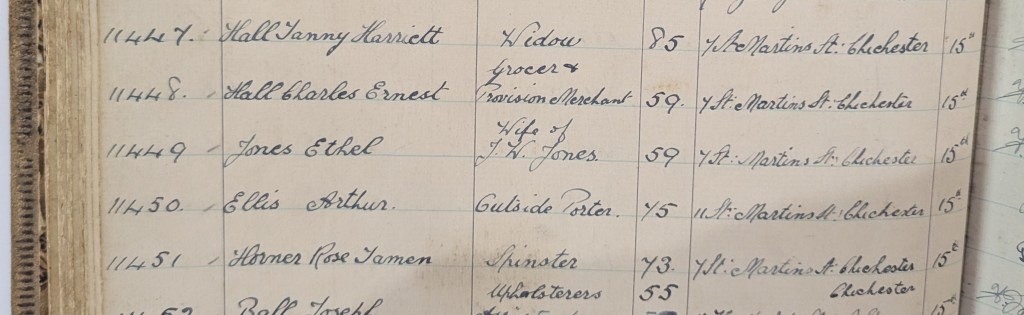
I have heard it said that the Crooked S acquired its current name because of the bomb damage it suffered, though this isn’t true as the name ‘Crooked Street’ appears on the first edition OS County Series map from 1875 (Sussex LXI.7.17). The buildings that were destroyed in St Martin’s Street were eventually rebuilt in the original style, restoring the street to its former, lasting character. Now when you walk down St Martin’s Street, it is difficult to imagine it cast over with rubble, just as it is difficult to imagine it swarming with pigs on market day. Chichester’s history, however, is rich and vibrant, and you need only keen and curious eyes to discover it, for it lies just beneath the surface.
Stay up to date with WSRO – follow us on Facebook, Instagram, Threads, Bluesky and YouTube

 West Sussex Record Office
Hi Lois Great article. I typed out a long comment but couldn’t send it as it wouldn’t accept my password even with resetting it. Si frustrating! Trina
LikeLiked by 1 person
What a very interesting and well written article. Based in Chichester for six months in the mid 1980s, I had no idea of its far reaching history other than the obvious Roman connection. A visit there last year showed it had not lost any of its charm but having now read this article, I feel the need to go back again and visit the places mentioned.
LikeLiked by 1 person
A very interesting and well written article. Whilst on a short term contract in Chichester in the mid 1980s, I had no idea of its far reaching history other than the obvious Roman connection. A visit there last year showed me Chichester had not lost any of its charm but having now read this article, I feel the need to go back again and seek out the places mentioned.
LikeLiked by 1 person
“In the Heart of Chichester: A Glimpse into the History of St Martin’s Street” is an exploration of one of Chichester’s most iconic thoroughfares, showcasing its historical significance, architectural charm, and cultural evolution. St Martin’s Street has long been a central part of the city’s urban fabric, connecting residents and visitors with heritage buildings, local shops, and stories that span centuries.
LikeLiked by 1 person