By Chris Olver, Project Archivist
In this post, our project archivist documenting HIV and AIDS archives in the UK gives a short tour of some of the online HIV/AIDS archives in the UK. This is second blog in a series and the first part can be found here.
In the course of my work so far surveying HIV and AIDS archive collections in England and Wales, I have come across some interesting examples of web-based archives created by private individuals. These archives are often self-funded and voluntarily run and may differ from professional archive services in how they present and describe items, but this differing approach is not necessarily one which is detrimental to the subject. Often these collections highlight new ways of viewing historical material or enrich the meaning behind digital objects by revealing personal stories or memories about them. In this post, I would like to pick out some examples that I have come across and included within my current survey.
HIV Graphic Communication
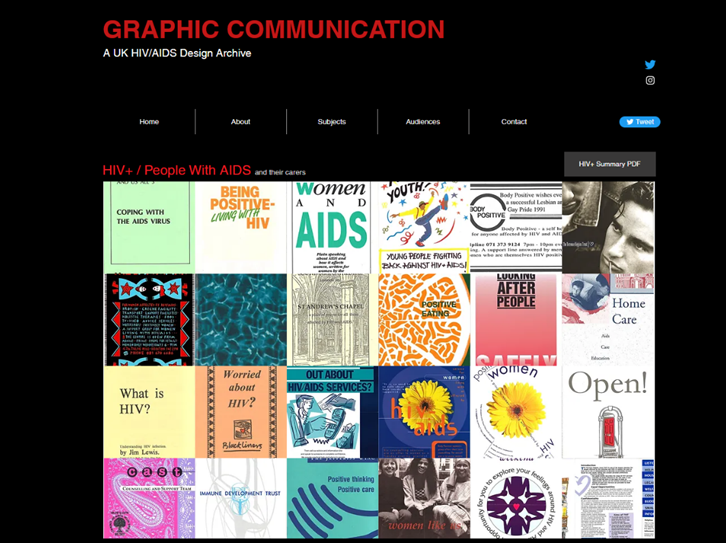
HIV Graphic Communication is a historic visual archive of promotional campaigns, advertising and graphic ephemera around HIV and AIDS in the UK and Republic of Ireland since the 1980s. The website was created by Siân Cook, a senior lecturer in graphic design who has had 30 years’ experience working with voluntary and charitable groups in the HIV/AIDS sector. Siân began collecting ephemera from HIV organisations in the early 1990s as part of her design work. The website is only a small taster of the physical archive that she has at her home.
HIV Graphic Communications is an incredible resource for studying the material culture of HIV and AIDS in the UK. The website contains digital images of HIV and AIDS printed literature from the 1980s to the present day, which demonstrates the changing ways that public health messages were communicated over the decades. Material has been ordered by subject or the intended audience of the publication and contains over 1700 examples of graphic ephemera, including from many voluntary and charitable organisations that no longer operate.
Alongside the online archive, there are several downloadable summary essays on various subjects, including HIV testing and condoms (https://www.hivgraphiccommunication.com/condoms). The latter of which brilliantly describes the initial coyness of UK government campaigns to mention condoms directly, before embarking on a series of condom ‘normalisation’ campaigns in the early 1990s [an example of which can be seen in the previous blog].
Queer Heritage South
Queer Heritage South/Queer in Brighton is a digital community archiving project, celebrating and promoting the rich cultural life of the Lesbian, Gay, Bisexual, Transgender, Intersex and Queer (LGBTIQ+) people in Brighton & Hove. One of the contributors, Harry Hillary, originally began creating a Brighton AIDS Memorial page on Instagram before transferring it to the Queer Heritage South website. Harry has added an online collection of 61 pages relating to the history of HIV in Brighton which includes moving testimonies of some of those who lost their lives to the disease along with pages on grassroot organisations and charities and images of demonstrations, exhibitions, and marches.
One of those featured on the memorial page, was Father Marcus Riggs (1955-1998), the Reverend at St Peter’s Church in Brighton. He had been inspired with the idea of creating a drop-in centre for those diagnosed with HIV in the city. In the early days, he could only offer peer support to those affected in his own flat, but through persistent lobbying persuaded the Chichester Diocese to fund a day centre in Brighton, and in 1988 ‘Open Door’ opened at 35 Camelford Street in Kemptown. The charity offered a place of sanctuary for people living with and affected by HIV, as well as providing meals for people five days a week. Father Marcus also served as a chaplain of the first specialist HIV ward opened at Hove General Hospital in 1990. He died from an AIDS-related illness on the 10 July 1998 and is buried at the Bear Road cemetery, Brighton.

AIDS Archive
The AIDS Archive is a YouTube channel set up by Martin Weaver in January 2021. Martin joined Terrence Higgins Trust in 1983 as a volunteer and by the mid-1980s he became the Trust’s first press officer. As part of his role, he video recorded the media appearances of members of the Trust, in order to evaluate their performances and see whether their message was getting across. Martin left the Trust in the 1990s and retrained as a psychotherapist but kept hold of the VHS tapes. They remained dormant until the Covid-19 pandemic at which point Martin was motivated to digitise and upload the tapes in his possession having seen the similarity with his own experience of HIV and AIDS crisis in the 1980s. He felt that they could provide some reassurance to people that we would get over the Covid-19 pandemic. He was also partially motivated by the then upcoming release of the Channel 4 drama, It’s a Sin, and wanted to ensure that the public and cultural response to HIV/AIDS in the 1980s was documented.
The channel contains video footage of magazine shows, news reports, documentaries, films and adverts from 1983-1995. Some of the recordings from the BBC or Channel 4 can be found in other archive repositories, but these are often not available to view online and in addition do not have the added commentary from Martin about the programmes at the time in his introduction to the video. For example, for the video, ‘Where there’s life’, an ITV series programme on science and medicine, Martin describes how some studio staff refused to work with a person with HIV for fear of contamination.
The channel also includes media appearances where archive copies may not exist such as an interview Martin gave to Cable Today Kingston & Richmond in 1994 about HIV/AIDS infections in Southwest London. And below is a very early HIV/AIDS information ad fronted by Claire Rayner broadcast on LWT television in August 1986.
West Yorkshire Queer Stories

West Yorkshire Queer Stories was a project which ran between 2018-2020 to capture LGBTQ+ stories from people of all ages and backgrounds in West Yorkshire. The site contains 200 audio and video recordings of people recollecting their lives from the 1950s through to the 2010s. The subject of “HIV” appears in 39 interviews and features interviews and clips with members of the LGBTQ+ community talking about such topics as coming out during the AIDS crisis, HIV and AIDS activism in Leeds and the more recent HIV/AIDS prevention work of organisations such as Yorkshire MESMAC.
The website is very easy to navigate and allows users to listen to or view the participants’ stories or access a transcript of the interview to read. The site also includes an interview with Howard Beck, a deaf man from Leeds who in his video interview gives his answers in British Sign Language (BSL) with the spoken translation provided as a soundtrack and written down in the transcription. The interview is especially valuable for history of HIV, as Howard provides an account of how HIV impacted the deaf community in the 1980s.
MayDay Rooms: London Lighthouse

The MayDay Rooms is an independent archive, resource space and safe haven for social movements, experimental and marginal cultures and their histories. The archive was established in 2014 in London and hosts the MayDay Radio website where volunteers use the equipment and skills of the archive to create new oral histories or experiment with sound production. One of the more recent projects has been on the London Lighthouse, an HIV drop-in centre and hospice which opened in Ladbroke Grove in 1986 and closed in 2013. The page was created by Sam Dolbear who through research began to accumulate a physical archive of materials relating to the Lighthouse.
The web archive features an interview recorded with Beattie Dray, a former nurse at the Lighthouse in the late 1980s, and digital images of some of the archive material in Sam’s collection. The archive was brought together by Sam in 2019, after he became interested in the history of the organisation. At the time, there was only fragmentary documentation about the London Lighthouse in archive collections (subsequently, some of its archive can be found in the Terrence Higgins Trust collection, held at the Bishopsgate Institute) despite the important role that it played in the history of HIV in the capital. The website is a useful resource as it highlights a neglected history of a once prominent HIV organisation through exploration of archive material but also the creation of new material through oral histories.
Stay up to date with WSRO – follow us on Facebook, Instagram, Twitter and YouTube

 West Sussex Record Office
Online archives for HIV/AIDS awareness are an important source for educating those afflicted with the disease. Thank you for taking the time to provide the public with these examples.
LikeLike