By Imogen Russell, Searchroom Supervisor
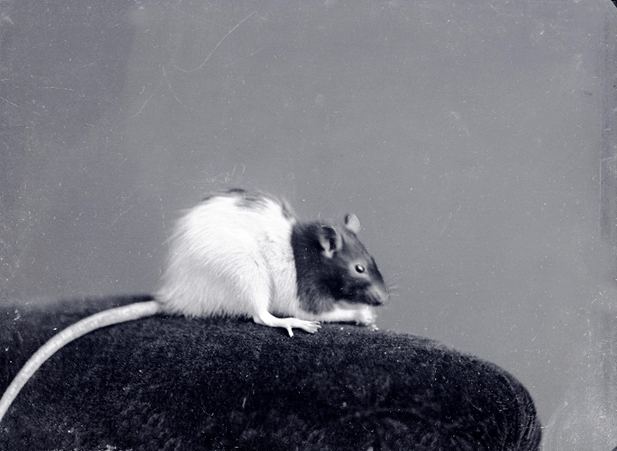
As with previous blog posts an animal has invariably had an intriguing impact on the subject matter, and this blog post is no exception. When looking at the catalogue description for Par 65/9/1 – the churchwardens accounts for West Dean, just north of Chichester, I saw reference to the payments for ‘sparrow heads and hedgehogs’ and was intrigued as to why the church would pay for these. So, I set about looking at the churchwardens accounts for some form of clue and what I found was much more than payments for sparrow heads and hedgehogs, but a wealth of information into the financial life a parish in the late 18th Century.
Let’s start with the Sparrows and the Hedgehogs
To answer the initial question of why churchwardens paid for sparrow heads and hedgehogs, we need to go back to the times of Henry VIII (1533) and Queen Elizabeth I (1566). When two laws were established to pay people for killing vermin (wild birds and animals) to protect England’s food supply.
The 1533 Act under Henry VIII was made in anticipation with his break from Rome. While the 1566 Act was amended to counteract the rise in food prices and stipulated payments were to be made by the churchwardens, instead of landowners or tenants and extended towards the payment for animals as well birds. Animals on the 1566 list of vermin to be sold to the churchwardens, included: foxes, badgers, polecats, weasels, stoats, wild cats, otters, hedgehogs, rats, mice and moles.
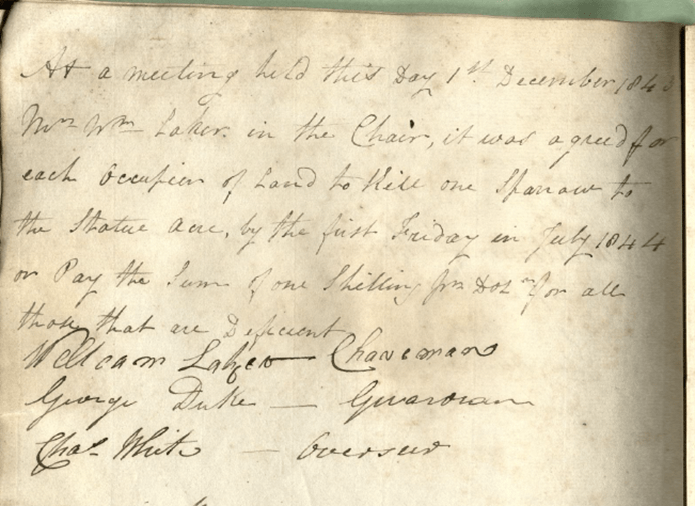
Interestingly the vestry minutes for Yapton (figure 2) makes three references in 1843 regarding the payment for killing sparrows, citing that each occupier of land must kill 1 sparrow per statue acre by a certain date or pay the sum of 1 shilling per dozen for those that are deficient.
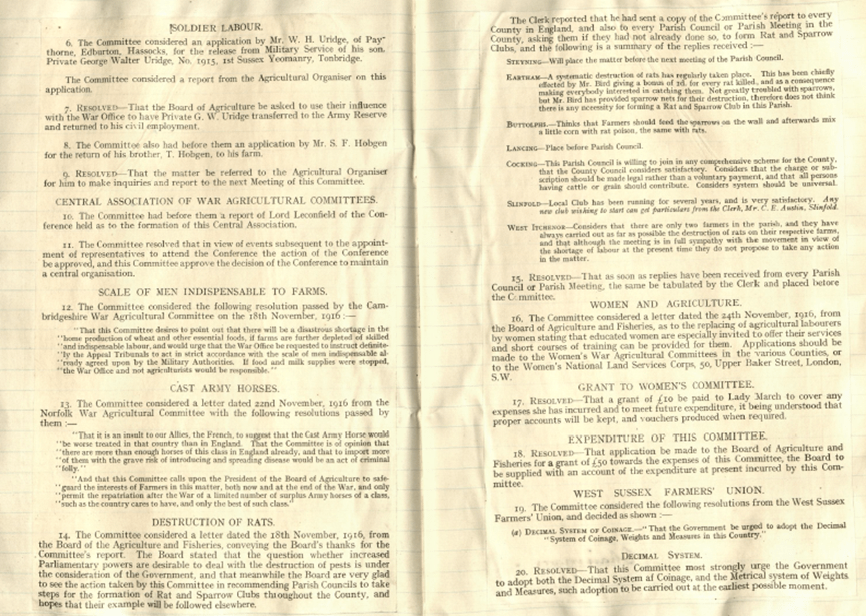
The practice of paying for killing wild birds and animals extended to 1863 when the 1566 Act was repealed. Although the question of the disposal of vermin arose again during the First World War when The WSCC War Agricultural Committee (WOC/CM 80/1/1) in March 1916 considered setting up a Pest and Vermin sub-committee to discuss the question of minimising the damage and destruction caused by vermin. At a meeting held on 7th July 1916, several references were made towards sparrow and rat clubs already in existence in Angmering, Selsey and Slinfold and it was resolved to do the same in each parish in the County. Replies from different parishes in the following minutes, give examples of how each parish planned to tackle the problem.
Ashurst formed their Sparrow Club in 1860 and suggested the delicacy of Sparrow Pie, to sharpen the mind and as a way of disposing of the heads.
What is a Churchwarden and what were their duties?
To understand the accounts in more detail, we must first look at the role and duties of a churchwarden. W. E. Tate’s The Parish Chest describes the churchwardens as the proper guardians and keepers of the parish church, while Colin Waters’ A dictionary of old Trades, Titles and Occupations adds to this by stating that churchwardens acted as treasurers and later general managers of the church’s activities and financial affairs. Therefore, keeping an accurate record of income and expenditure would be key to being a good churchwarden.
Two churchwardens would be elected yearly usually around Easter, with the joint consent of the minister and parishioners. However, for larger areas this could mean the election of four or more churchwardens.
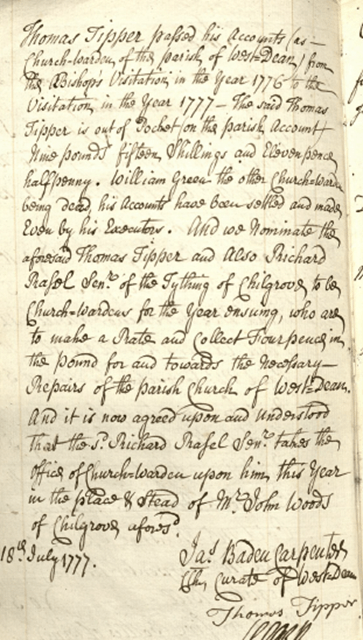
The West Dean accounts records who was churchwarden for the coming year or years and in this volume (Figure 4), we can see evidence of the same churchwardens being elected repeatedly or serving for multiple years. As well as the election of a churchwarden when one of them dies.
One of the roles of the churchwarden was to inform the bishop, on misbehaving clergy, parishioners, and any other issues within the parish that the bishop needed to know. If you are interested, the churchwardens presentments in Sussex Records Society volumes 49 and 50, available in the searchroom or online https://www.sussexrecordsociety.org/srs-digital-editions-historic-volumes/, represent a good example on the types of things that the churchwardens would be reporting on.
What do the accounts tell us
Lets now look at the accounts and see what they tell you. The disbursements in Par 65/9/1 (figure 5) start in 1766 and within the first few pages we see payments are made to the Vicar for keeping the Register; Wine and Bread for the sacrament is brought, relief is given to sailors on the road, repairs are being done to the church, horse and carts are hired to obtain supplies for repairs the church, the bell ringers, clerk and cleaners are paid. Finally, between 1766 and 1783, prayers are said for Queen Charlotte, presumably upon the birth of her children, as each prayer coincides with their birth.
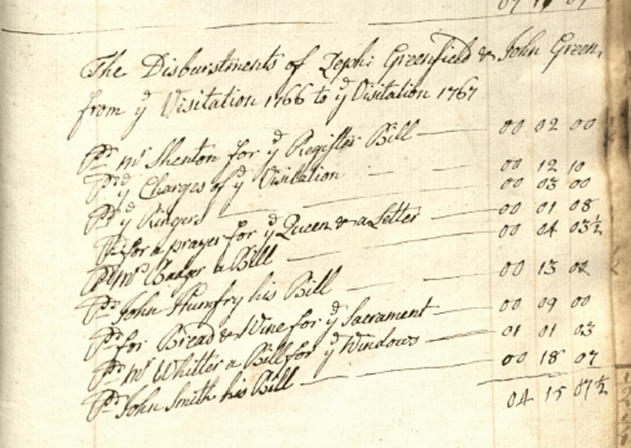
The churchwardens did the yearly account declarations and nominations state how much is left in or out of pocket. In the accounts for 1772 we see Richard Budd, churchwarden in 1771 is reimbursed with £1.0s.7¼ d (what he was out of pocket by).
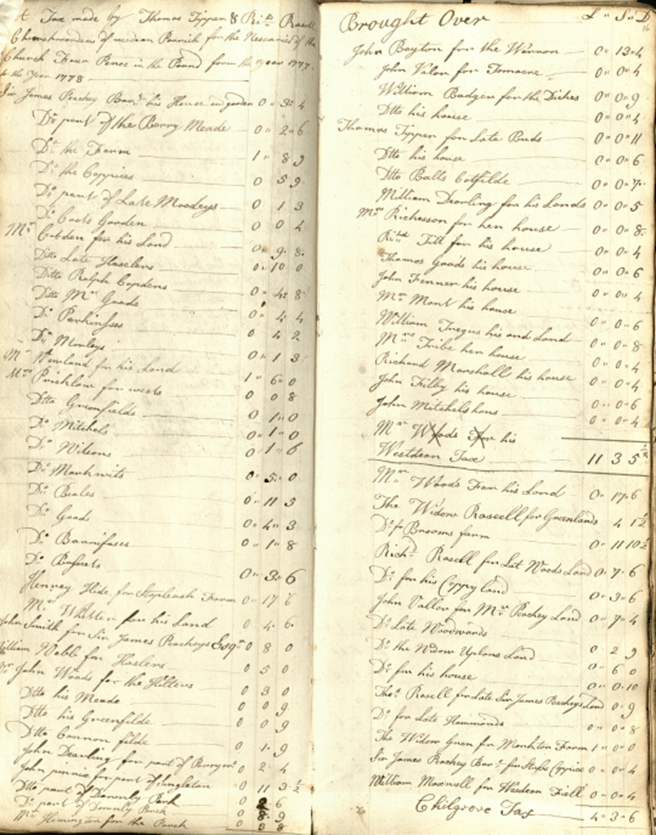
The accounts also state the rate collected for each year, before finally compiling a yearly list of the prominent landowners and what they owed. The first list called a tax was compiled in 1778 and states the land for which the tax was issued. With this list we not only get an idea on the wealth of the landowner, but we also get their name and as they split the list in to two (a West Dean tax and a Chilgrove tax) we see the area where each landowner might have lived (figure 6).
As you can see a wealth of information can be found with churchwardens accounts and can be used in all manners of research projects. If you would like any advise on using and accessing such records, please email your enquiry to record.office@westsussex.gov.uk.
Stay up to date with WSRO – follow us on Facebook, Instagram, Twitter and YouTube

 West Sussex Record Office
A wonderful account Immie, well done. I was researching Sutton Poyntz Parish Vestry Minutes in Dorset about 30 years ago and came across a payment for a “grey” in between the listings for sparrows and a badger. The year was 1776 and a century before the introduction of the grey squirrel so it wasn’t that. Nobody in the Dorset Record Office could enlighten me as to what the creature could have been and I’ve been mystified ever since.
LikeLiked by 1 person
Thank you, Trina, for your lovely comment. I’m glad I could enlighten you on your research after 30 years.
If you are interested in reading further on the subject, there is an interesting article by Douglas Anderson in The Hampshire Field Club Archaeological Society. Vol 60, 2005, pages 209 – 228. https://www.hantsfieldclub.org.uk/publications/hampshirestudies/digital/2000s/vol60/Anderson.pdf
– Immie
LikeLiked by 1 person