By Chris Olver, Project Archivist
In this blog, our Documenting HIV Epidemic Project Archivist provides a short history of the impact of HIV on Sex Education teaching in schools in the UK, and how the West Sussex charity, AVERT, contributed to educating young people about the risks of HIV and AIDS, using examples from the charity’s archive held at WSRO.
Since its inception, sexual education in schools has been hotly debated as to whether it belongs in the classroom. The subject has often evoked moral objections and for a long time was seen as taboo, and what little that occurred generally related towards ‘hygiene’. Anything beyond this was seen as transgressive, as was the case of Miss Outram, a school headmistress in Derbyshire, who in 1914 told her class of 11-year-old girls two heavily allegorical short stories about childbirth and relationships. Neither of these stories mentioned sex or sexual acts. The lesson led many of the parents boycotting the school and the local school board asking for her resignation.
The historian, Ellie Simpson, has noted that sexual education policy is often implemented as a response to a sense of ‘changing times’ relating to the sexual morality of young people. When the first UK government guidelines were published in 1943, they stated that the publication was brought about by circumstances of wartime and the social dislocation arising from it was liable to break down sexual constraints.
During the 1980s, the global HIV epidemic led to calls for better school Sex Education in the UK. One leading epidemiologist saw it as a natural development from lack of scientific curative options.
‘It will be a long time before we control AIDS, so the only other option is behavioural change – so we’ll go in at the school level” [quoted in Virginia Berridge, AIDS in the UK: The Making of Policy, 1981-1994, 1996, p263].
Whilst there was broad scientific consensus that education was a vital part of HIV prevention strategy, there were moral and political objections to some of the content of the sexual health information that was put forward for teaching. The HIV education charity AVERT was, from the late 1980s, deeply involved in these debates through its own HIV education publication programme.
Learning About AIDS
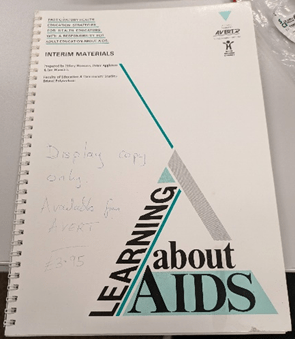
Annabel Kanabus (who went on to found AVERT) first became personally involved in HIV and AIDS, when she was contacted in 1985 by a London hospital, St Mary’s Hospital in Paddington, London, which was looking for donations to fund their research into the disease. In February 1986, she visited the hospital and what she learnt shocked her, finding out true extent of the disease both for men who have sex with men and heterosexual populations here and in sub-Saharan Africa.
The visit spurred Annabel on to fund a 3-year grant at the hospital but also to use her own inheritance to set up a charity with her husband, Peter, that would fund HIV and AIDS research. The charity AVERT (AIDS Virus Education & Research Trust) was founded in 1986, and initially operated from the attic of their farmhouse in Horsham, West Sussex.
One of their first projects that year was to fund the development of a HIV and AIDS teaching pack for health educators, Learning About AIDS, produced by Peter Aggleton, a health educator from Bristol Polytechnic (now the University of the West of England). The project was run in conjunction with the Health Education Council (HEC), the government funded organisation involved in health promotion. By early 1987, the project had produced a “Starter Materials” pack which was freely distributed. However the publication of the main pack would run into difficulties.
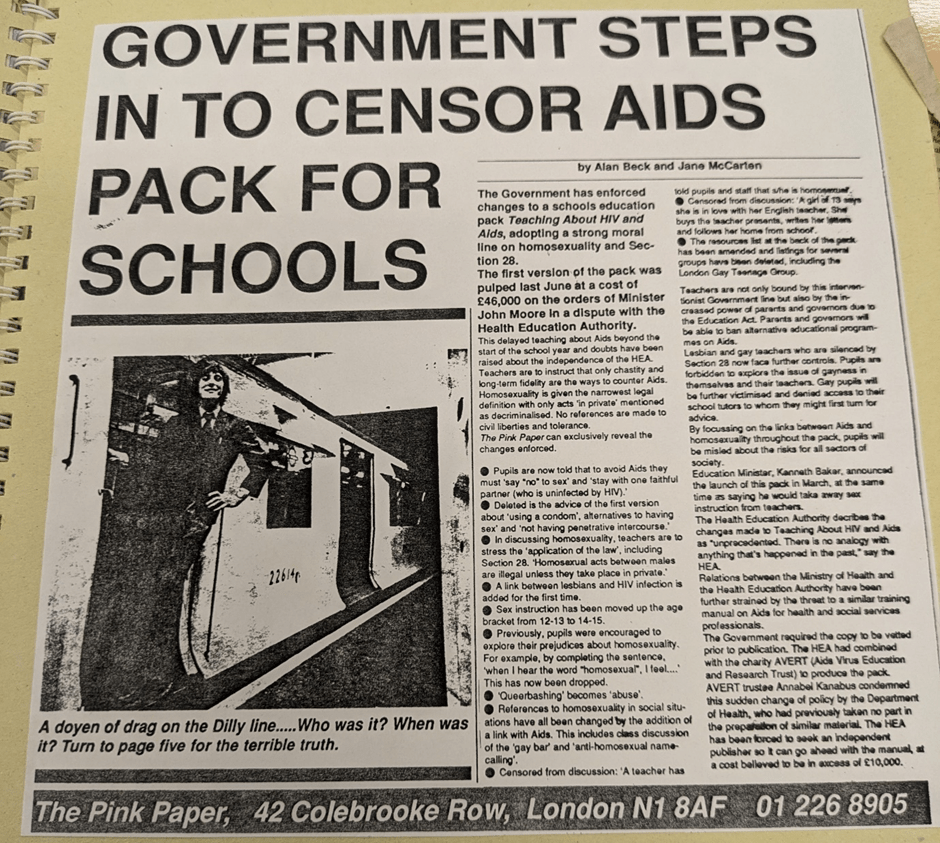
HEC was replaced by the Health Education Authority (HEA) in April 1987. The HEA were less independent than the HEC and everything they published had to be approved by the Department of Health. In late 1987, HEA were required to scrap and re-write the first edition of another HIV education publication, Talking About AIDS, designed for school health education programme, due to government objections. Similar objections were raised with the ‘Learning About AIDS’ interim publication with the Department of Health pushing for a more ‘moral’ stance; for example, suggesting that it was the number of partners rather than particular sexual activities and whether a condom was used, that determined the risk.
The final text was delivered to the HEA in May 1988. AVERT and the authors were informed that the Department of Health would have to approve it for publication and that “this might involve an extensive re-write- there are certainly some exercises that would not be approved”. All parties involved in the book refused this request and a compromise was made whereby an independent medical publisher, Churchill Livingstone, was found to publish the material.
“The HIV/AIDS Education & Young People Project”
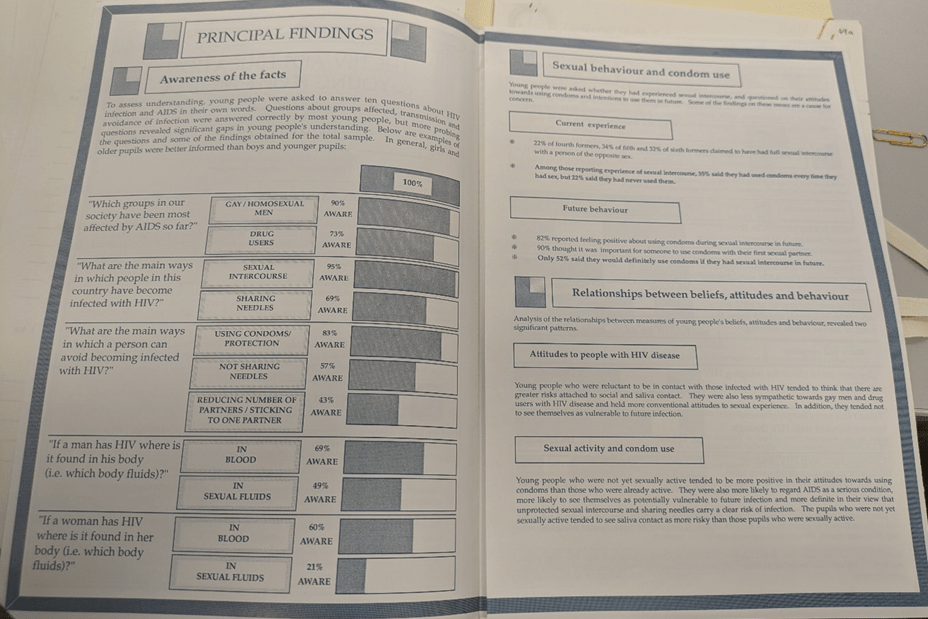
Despite these early difficulties encountered in HIV and AIDS education, AVERT were not dissuaded from funding further projects on health education. The next education project they funded was a survey by the HIV/AIDS Education Research Unit at Christ Church College, Canterbury, to investigate young people’s knowledge and beliefs about HIV infection and AIDS. An anonymous questionnaire was sent to 1000 secondary school children in southern England between the ages of 14-18 years old. The survey results showed some awareness of the basic facts of the disease, but also found that some of the children thought you could get it from everyday contact or kissing. The researchers were surprised by the number of participants who were sexually active, with only a third saying that had used condoms and a quarter saying they had never used them.
The questionnaire included a section which allowed young people to write any remaining questions they had on HIV and AIDS. The authors of the survey were surprised by the number of replies they received and, on the basis of these responses, AVERT and the senior researcher, Stephen Clift, created the booklet, AIDS & Young People, in 1989. The booklet answered the questions asked in the survey, reproducing the language that the young people themselves had used in their responses. By 1989, nearly 250,000 copies had been distributed throughout the UK and overall 1.5 million editions of the book would be distributed from 1989 to 2000.
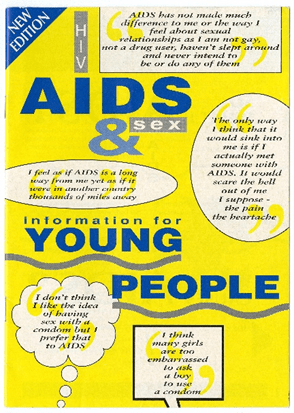
In an article in the Evening Argus about the release of the 1992 edition of their advice booklet, Annabel Kanabus stated that “The updated book answers youngsters’ questions in an honest, upbeat way and does not just tell them what we think they should know”. She added: “They just want to know how they should behave on Saturday night. Many think they know a partner if they have said ‘hello’ on another occasion before having sex. But meeting someone and thinking they come from a nice background does not mean they are not infected’.
Legislative change but sex remains taboo
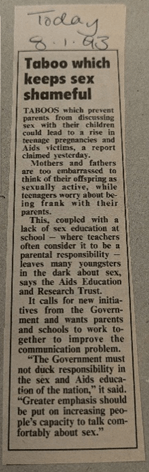
For AVERT and the researchers, the survey highlighted a need to provide sexual health information to children before they are sexually active, with the evidence suggesting that many of the children surveyed were having sex below the legal age of consent. By the early 1990s, there was growing concern about the rate of teenage pregnancies and the government white paper, The Health of the Nation: A Strategy for Health in England, published in 1992, prioritised the need to improve sexual health in schools to reduce HIV infections and the rate of teenage pregnancies [Berridge, p263]. The following year, the 1993 Education Act made the teaching of HIV and AIDS compulsory on the National Curriculum for the first time. Its admission only allowed the biological aspects of HIV infection to be covered and there was a focus on the promotion of the value of stable family life, marriage and responsibilities of parenthood. This was a step forward from previous Health Education Act in 1986 which gave school governors the right to refuse to have Sex Education at all in their schools. The government tried to mitigate the potential negative reaction from some parents by allowing them the option to withdraw their children from Sex Education classes. While these legislative changes allowed Sex Education to be taught in all schools in England and Wales, the teaching remained inconsistent with much of the responsibility varying from school to school and individual teachers taking responsibility for what was discussed. In an article in The Independent in 2000, Annabel Kanabus reflected back on legislative change in the late 1980s and stated that the period was a ‘real watershed’, as ‘it became acceptable to talk about condoms and oral sex in a way that it had not been before’. However, she noted that while some schools provided an imaginative and wide ranging programme on Sex Education, some schools could satisfy their legal requirement by providing a single 40-minute lesson for 15-year-olds before they left school.
The legacy of Section 28
However, sexual education legislation in the 1980s and 1990s did not provide any guidance on sexual health and relationships for those who identified as anything other than heterosexual. It was widely percieved that the Section 28 legislation brought in by the government in 1986, prohibited the teaching of or the promoting of homosexuality in schools. Surprisingly, this was not the case, as a government circular in 1988 stated that Section 28 ‘will not prevent the objective discussion of homosexuality in the classroom, nor the counselling of pupils concerned about their homosexuality’, yet the guidance was little known and the result was that schools and teachers tended to avoid the subject.
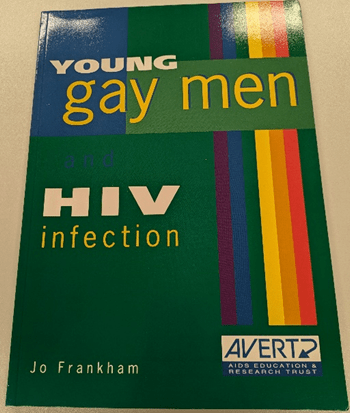
The AVERT publication, Young Gay Men and HIV Infection in 1996, provided evidence of the lack of discussion of homosexuality in schools. The author, Jo Frankham interviewed a number of young men from across the country on their experience of adolescence. Many noted that homosexuality only came up as a passing reference in Sex Education that typically consisted of a single statement like “it’s not just a gay disease” or “everyone can get it not just gays and drug users”. Such pronouncements ironically reinforced the perception that it was a ‘gay problem’. The report stated that of the young men interviewed for the project, “almost all… desperately wanted to be given unbiased information about homosexuality at school, or in other venues where they socialised, like youth clubs. They felt this would have been helpful to them but would also, hopefully, help straight teenagers begin to understand what they were going through”.
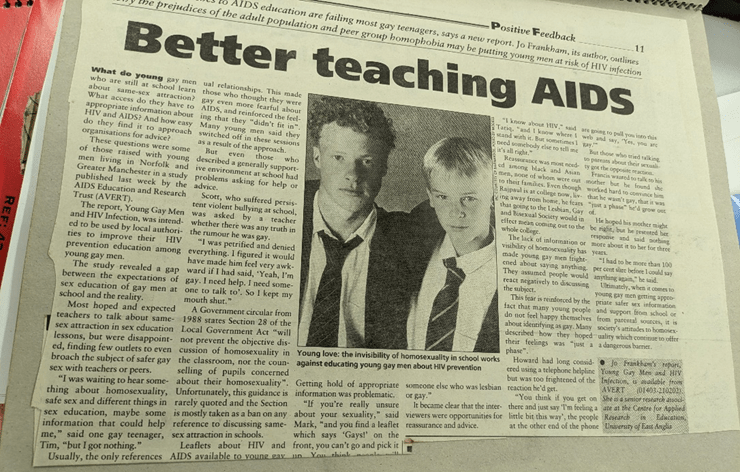
Though Section 28 was repealed in Scotland in 2000 and rest of UK in 2003, it was not until 2020 that a programme of LGBT inclusive Relationship and Sex Education became compulsory in all schools.
Conclusion
The HIV and AIDS epidemic had a sizable impact on Sex Education on schools in the UK during the 1980s and 1990s. The ensuing social research on attitudes and behaviours of young people underlined a perceived need for sexual education provision in schools and this was formalised in government legislation most notably the 1993 Education Act. Yet, the type of sexual education received was still dependent on the willingness of schools to teach it, and whilst some schools sought out advice and guidance from sexual health education charities such as AVERT, some continued to only provide the bare essentials to their students.
End Note
Annabel Kanabus, 25 Years of AIDS – A History of the HIV/AIDS Charity AVERT, 2012
Stay up to date with WSRO – follow us on Facebook, Instagram, Twitter and YouTube

 West Sussex Record Office
Excellent article. Well done 👍
LikeLike