By Alice Millard, New Jerusalems Project Archivist
Crawley has been synonymous with Gatwick Airport for almost as long as the new town has been in existence. Residents of West Sussex are well aware of Crawley’s impact on the county, but for those outside of the county, many discover the town in relation to Gatwick as one of the several million passengers who pass through each year. But, what is Gatwick’s history?
Beginnings
Gatwick got its name through the de Gatewyk family whose ownership of land in the area went back to the medieval period. The earliest reference to the de Gatewyk family that we hold in the Record Office is for a John de Gatewyk who is mentioned in a conveyance dated 1344 (ref: Par 183/24/1/1). Fast forward a few hundred years, and the Gatewyk family’s land was sold to William Jordan (whose family were also from the area) and who went on to build Gatwick Manor House in the early 1700s.
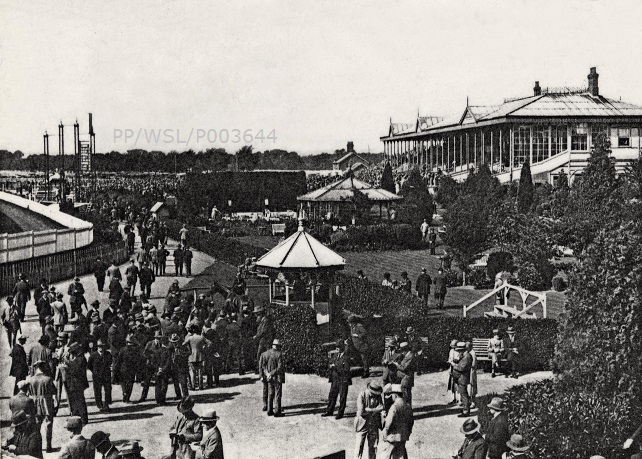
For a long time the Manor House and Park were used by descendants of the Jordan family until 1890 when they sold the land to the Gatwick Racecourse Company, which sought to capitalise on the proximity of the then new(ish) Brighton to London railway line. A brand new Gatwick Racecourse station was also erected. Then, during the First World War, the racecourse played host to the Grand National and continued to entertain the upper echelons of British society.
1920s-1930s
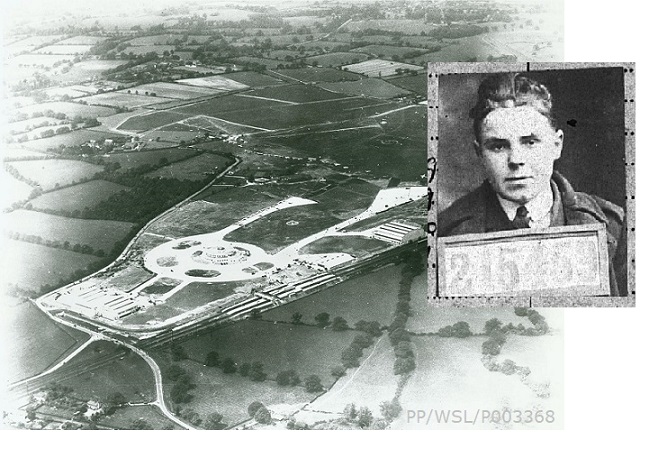
The prosperity of the 1920s and the rapid development of an exciting new technology led to a boom in aviation. Hundreds of newly qualified hobbyist pilots were taking to the skies. In 1930, a pilot called Ronald Buckland Waters noticed that a farm called Hunts Green, which abutted the Gatwick estate, was up for sale. Waters notified the Air Ministry of its potential as a significant aerodrome. Not bothering to wait for a reply, Waters went ahead and purchased the land from owner Louisa Robinson, relation of Sarah Robinson who founded a school in her name in Crawley. Throughout the 1930s, the Surrey Aero Club was based at the newly established aerodrome and helped to put it on the map. Its popularity grew and a terminal was built in 1936. It was fondly known as the Beehive and was a round construction that you can see in the adjoining image.
1940s
“It is true that the Ministry of Civil Aviation have been tiresome in delaying their observations on your Master Plan and in bringing forward at this late hour vague proposals which might have far-reaching influences on that plan.”
Ministry of Town & Country Planning to Crawley Development Corp., 28 Nov 1949
It’s worth noting at this point that horse racing was still taking place at Gatwick regularly up until the late 1930s. Its recognition as an excellent air base during these years caught the attention of the government and during the Second World War it was requisitioned by the Royal Air Force. Gatwick’s era as an international airport was still to come. As the aerodrome was winding down its military responsibilities, Britain’s post-war government deliberated over its future as they arranged to decommission it. In the run up to the designation of Crawley as a new town, which happened in 1947, concerns about Gatwick’s future as a major airspace were raised but plans for the new town went ahead on the assumption that it would not become the major airport it is today. Its future size and impact on Crawley could not have been predicted.
1950s
Despite assumptions that Gatwick wouldn’t affect the development and future of the new town, just a couple of years into planning, fresh concerns were mounting about the impact a major airport would have to the town. In August 1949 the Ministry of Civil Aviation issued a memorandum which outlined their current thinking. It also included news that Marcel Desoutter, a partner in Morris Jackaman in Airports Ltd and co-owner of Gatwick, thought the government “ought to keep Gatwick on indefinitely and use it as a diversionary aerodrome for B.E.A.C.’s regular services“.
In December 1950, a full three years after Crawley was designated and a year after the town’s Master Plan was published, a report indicated “it [Gatwick] will either be closed down or substantially extended” – they still had no idea. It is interesting to read through the Development Corporation’s administrative files on this topic. In response to these developments (if they could be called that), the Chief Executive invited the opinions of the Chief Architect, Chief Finance Officer, and the Deputy Chief Executive. Their replies were kept and filed away. All of them seem to have not felt confident about a large expansion of the airport, worrying that such an increase in employees to house would be a strain and they were also concerned about the risk of noise and accidents. However, they could see the opportunity for further economic invigoration – an important facet of the new town movement.
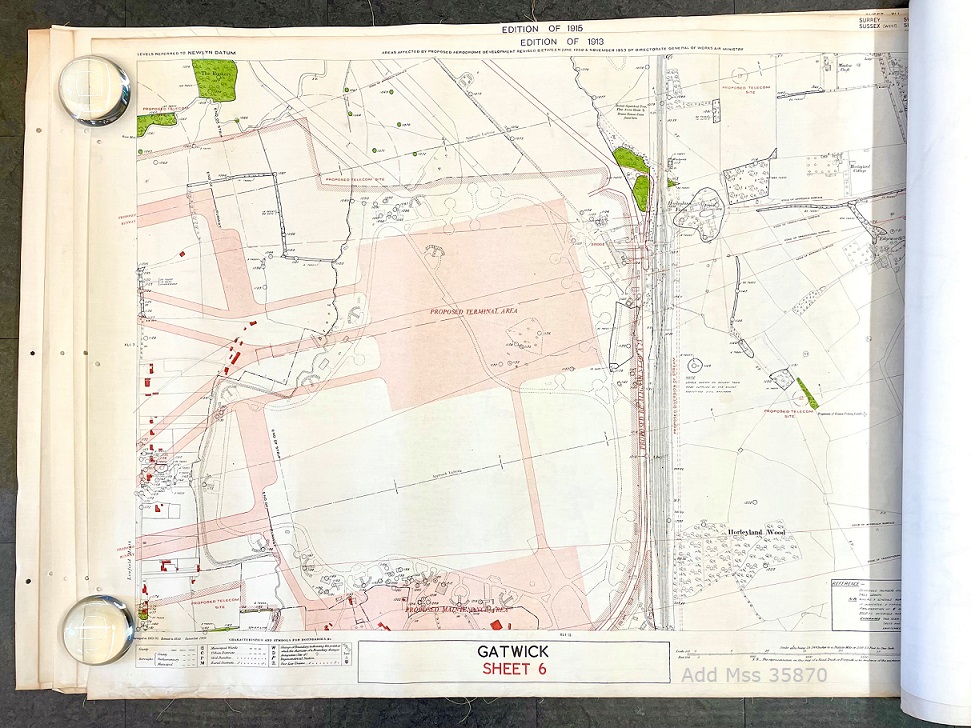
A little time went by, and in 1952 it was agreed that Gatwick would become the UK’s second airport, relieving the strain on London [Croydon] Airport. But, to make it viable as a secondary airport, a huge amount of development was needed. The same Ministry memorandum from 1949 read,
“to enable Gatwick to be used as an alternate it will be necessary to provide hard runways and passenger handling buildings at heavy capital, maintenance and staffing cost”.
Ministry of Civil Aviation
The view of the Corporation was that:
“It is clear that the Ministry of Civil Aviation have taken very extensive steps to so designed any future air operations at Gatwick that they will have the minimum effect upon the New Town, and that they have examined a very large number of alternatives before pressing their claims on Gatwick.”
Crawley Development Corporation
Work to expand Gatwick as an airport began in 1953 and it was officially opened on 9 June 1958 by Queen Elizabeth II.
1960s-1970s
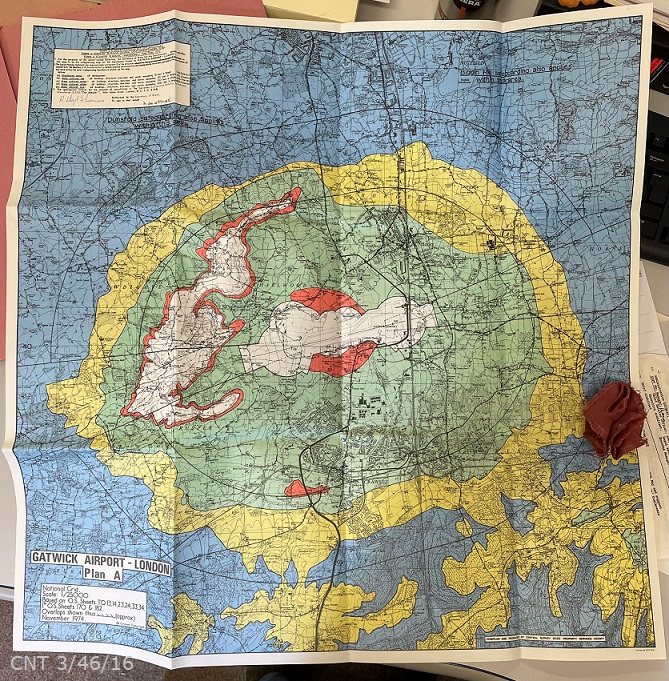
After a decade or so of tourism and passengers, increasing demand was being placed on the airport and the decision was taken to assess expansion. In the Crawley New Town Archive are several files dedicated to the expansion and they reveal the involvement that the Commission for the New Towns had with the British Airports Authority and the Department of Trade and Industry’s plans. What ensued was almost another decade of deliberation and surveying. What transpired over these years was a mounting feeling that, as put by the chair of Crawley Parish Council, “every local authority, from the County Council downward was strongly opposed to the enlargement of the airport.” Eventually, in 1979, the government agreed with the County Council not to build a second runway until 2019.
1980s
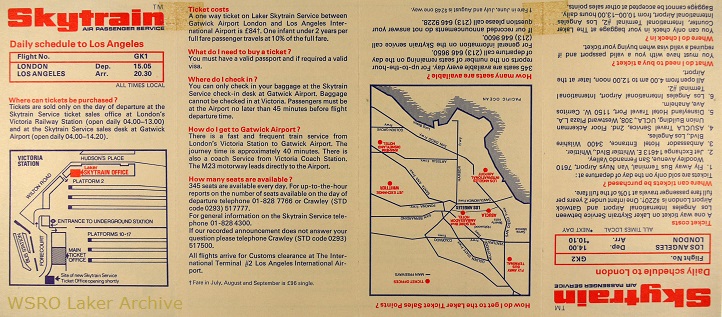
Despite the absence of a new runway, Gatwick thrived. There are a few airlines which are synonymous with Gatwick today – British Airways, easyJet, Wizz, and TUI to name a few. But one of the earlier major airlines associated with the airport was Laker Airways. The airline was founded by Sir Freddie Laker, a serial entrepreneur who had made a name for himself in the aviation world by establishing Aviation Traders in 1947 and managing British United Airways between 1960 and 1965.
At the Record Office we hold the archive of Sir Freddie Laker. The archive contains many of his personal documents, some regarding his early aviation business interests, but mostly consists of records of Laker Airways and its subsidiaries such as the Skytrain service. Through these records, we can track the increasing accessibility of air travel for the general public and the effect this had on demand, and subsequently on Gatwick Airport.
Whilst the original giants such as British United Airways, Caledonian Airways and Laker Airways eventually ceased to exist, others took their place. During the early 1980s, Sir Richard Branson was forming his own transatlantic airline, with the guidance of Sir Freddie. Virgin Atlantic began its service at Gatwick and was based there until 2020, when it transferred all operations to Heathrow. But Gatwick’s legacy as a hub for pioneering aviation business is clear, and Virgin Atlantic still has their headquarters in nearby Manor Royal industrial estate in Crawley.
Lasting impact
Gatwick continues to be one of the UK’s busiest and most iconic international airports. It also continues to be in the public eye, never more so than during the Covid-19 pandemic when the threat to the airline industry was considerable, and also now as the question of a second runway, originally raised in the 1979 agreement, is under discussion. For Crawley, Gatwick is still a major draw for companies based in the Manor Royal industrial estate, built by the Development Corporation during the late 1940s. Clearly, the history of the two are intertwined, as is their future.
Stay up to date with WSRO – follow us on Facebook, Instagram, Twitter and YouTube

 West Sussex Record Office
Thank you for an excellent article Alice detailing the history of the land. It’s heartening that the airport name continues it’s association with the original landowners and hasn’t been lost through time.
LikeLiked by 1 person