By Jenny Bettger, Research Assistant
When researching genealogy, you often come across individuals or family groups that stand out. This was the case for me with the Glue family, who I discovered when I was looking at families with longstanding links to the Rogate area. The Glues, or Clues, as they were also known, were a large family with branches living in the Rogate, Harting and Marden areas in the 18th and 19th centuries. These areas were and are still rural, with few opportunities for work outside of the farms and estates. Census records show the majority working as Ag Labs (agricultural labourers), work which was often seasonal and poorly paid. The Rogate branch of the Glue family seemed to have struggled with rural poverty and had frequent run-ins with the authorities for various crimes. They regularly appear in the parish poor relief records prior to the opening of the union workhouse at Midhurst in 1835.
Thomas Glue along with his wife Ann Guyat were the parents of at least ten children born in Rogate between 1783 and 1800, all but one of them surviving until adulthood. In the Overseers account book for the poorhouse in Rogate (Par 159/31/1) their children are listed in receipt of clothing between 1803 and 1811. The items they received included ready-made items such as shoes and stockings but, in many cases, they were given lengths of material to make up their own clothes. The most common material they received was dowlas, a strong coarse linen cloth, which is apparently identical to sail cloth. This was obviously hard wearing but probably not very comfortable.
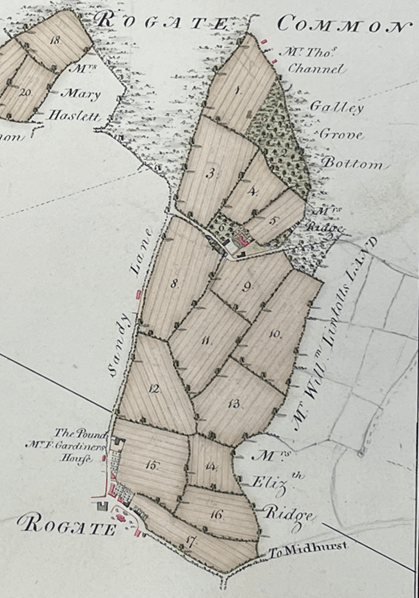
In some accounts the children appear to be living in the parish poorhouse, in others in Galley Grove situated to the north of the village. This area was named after the place of burial of a victim of the notorious Hawkhurst smuggling gang in the 1740s. Thomas Glue is listed as an occupier of a property in Galley Grove in records relating to the diversion of a footpath in 1824 (QR/W733). The vestry minutes for Rogate (Par 159/12/1) mention several cottages in Galley Grove belonging to the parish and housing families in receipt of parish relief including members of the Glue family. The cottages were later sold after the union workhouse in Midhurst was opened in 1835.
Due to the insecure wages and meagre poor relief, poaching and other petty crime appeared regularly in the court and newspaper reports for the area. In 1809 Thomas and three of his children Thomas, Elizabeth and John were accused of stealing a ‘wether sheep’ from W Cox. Although they were acquitted at the Lent assizes this was not the family’s last run in with the law. In all, five of Thomas and Ann’s children were convicted or acquitted of various crimes, but for now, I will just go into John’s story.
After his early run in with the law at the age of around 15, John does not appear again before the courts until 1820 when he was listed as a deserter. Later records refer to John being in the army, but I was not able to find any enlistment or service records to confirm this. Back in Rogate John seemed to have a difficult relationship with the local parish overseers who were responsible for providing poor relief. In 1823 he was bound over to keep the peace after threatening John Colebrook the assistant overseer. In the quarter sessions for October 1823 (QR/W729/104) there is a witness statement from Colebrook describing the events. John had been employed by the parish to carry out work and was paid but then did not complete it. When he was challenged, he then threatened to ‘break every bone in his skin’.

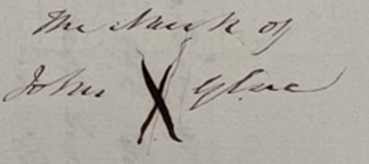
In 1828 John was convicted of stealing a barrowload of building stones valued at only 3d. Unfortunately, the stones were the property of the overseers of the parish, and he was sentenced to 1 month’s hard labour. His final conviction was in October 1834 for stealing a pair of axle trees from Joseph Tipper. According to witness statements his house was searched, and the items were found. He claimed he had purchased them, but this was not believed, and he was sentenced to be transported for life. He marked his own witness statement with an ‘X’ showing he was illiterate.
The sentence appears harsh for the crime, and this was a sentiment that appears to be shared with many from Rogate. In a petition found on Find My Past, John, his wife Ann, Joseph Tipper the victim of the crime, as well as others beg for mitigation or shortening of John’s sentence. The petition gives details of his service in the 40th Regiment of Foot including at Waterloo and describes him being in poor health. A plea from his wife illustrates her feelings:
“Petitioner begs leave to say that her husband is ruptured and in very bad health from hard service in the Continent and could never survive the voyage to a distant land and she is a poor forlorn stranger here.”
[HO17/105/TT32 on Find My Past]
A note on the petition describes John of being of bad character and his previous convictions counted against him. So unfortunately for John and his supporters, the petition was unsuccessful. On 18th November 1834, a month after his conviction, he was transported from the prison hulk where he was held at Portsmouth. The voyage lasted almost four months, arriving on 3rd March 1835 in Van Dieman’s Land (now called Tasmania). The reports of John’s ill health appear to be correct as he died on 23rd March, within weeks of his arrival.
Information on what happened to his wife Ann is limited, she may have been convicted of stealing wood in Rogate in 1835 along with her sister-in-law of the same name. After this it has been difficult to trace her as there are multiple Ann Glues of a similar age living in the area and she may have moved away and remarried. John was not the only member of his immediate family who was transported for his crimes, but their exploits are too numerous for this blog so I may return to them in the future.
The Record Office holds collections of parish and workhouse records for across West Sussex, as well as historic court records (quarter sessions). You can search our catalogue online here. Subscription websites Ancestry and Find My Past hold a variety of records related to the courts and prisons. Crime and court cases were regularly reported on in the local newspapers and often contain more detail than found in the official records. The Convict Records database is an invaluable free resource for researching transportation to Australia.
Stay up to date with WSRO – follow us on Facebook, Instagram, Threads and YouTube

 West Sussex Record Office
That’s a really great article Jenny. Thank you for the pointer of the Convict Records database. I’ll take a look.
LikeLiked by 1 person