By Louise Conway, Archives Assistant
In this first part of a two part blog series we will be exploring the history of Shoreham’s Bungalow Town. To begin we will look at Shoreham pre Bungalow Town and the moving onto the early days of the site, the bungalows themselves and what life was like. This blog post will conclude with the end of Bungalow Town, however, we are only delving into a small part of its history. The second part of this series will look at how it became known as ‘Britain’s Answer to Hollywood’!
Pre Bungalow Town
From pre-Roman Old Shoreham to the town and port of New Shoreham towards the end of the 11th century, Shoreham has seen continuous developments. Made a Royal Port in 1208 and considered a major shipping centre by 1346. With the rapid growth of its neighbouring towns, and the arrival of the Shoreham Branch of the London and Brighton railway in 1840 Shoreham continued to evolve with the times.
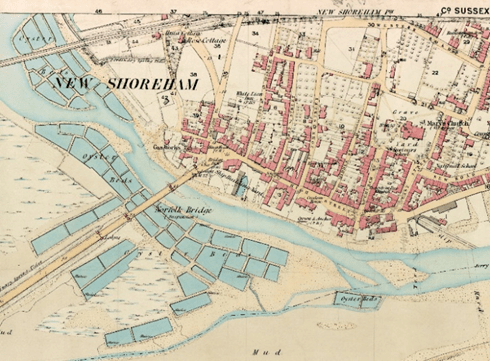
Shoreham Beach is fundamentally a shingle spit deposited over millennia by longshore drift, and it is here that Bungalow Town was built. Although the land belonged to the parish of Lancing, as the only access to it was from the town in Shoreham, as far as civil government was concerned, it became known as Shoreham Beach.
Early days of Bungalow Town
Bungalow Town got its name in early 1900s, although there are traces and tales of sporadic dwellings on the beach prior to this.
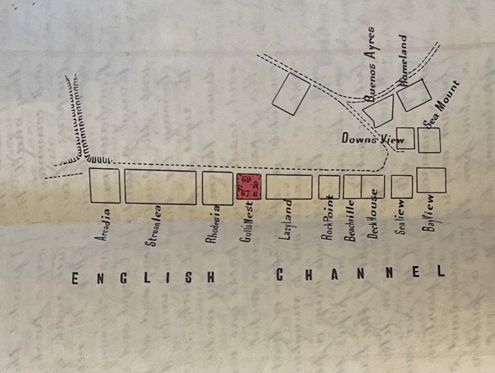
Initially the bungalows held no proper addresses, instead, each held a unique name, such as Gull’s Nest or Seaview. Eventually street names were adopted; Old Fort Road (for the row of bungalows leading off from The Old Fort) and Beach Road (from Ferry Road, leading towards The Church of the Good Sheppeard).
Not the first, but credited with making the area ‘fashionable’, music hall entertainer Marie Loftus (1857–1940) travelled down to Shoreham after an engagement in Brighton and found a handful of bungalows and fisherman huts on the beach. There was such an appeal that she arranged to have her own bungalow built and named ‘Cecilia’ after her daughter.
The Bungalows
Built around redundant railway carriages that were brought cheaply from Brighton Railway Company for around £10. For an additional cost they were transported to the beach by horse-pulled wagons, across the River Adur at low tide.
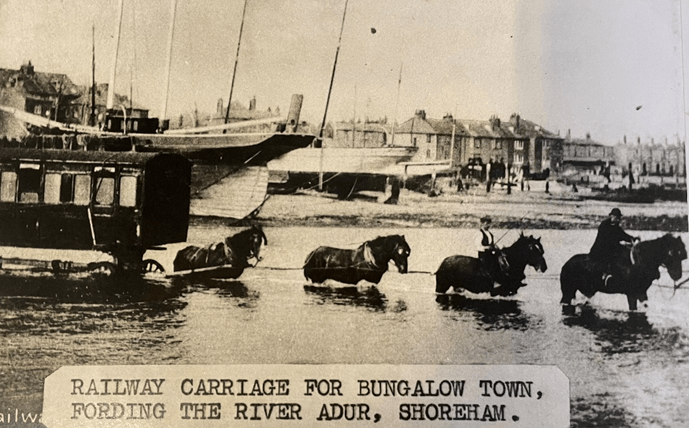
Basic bungalows consisted of a concrete foundation, two railway carriages, with a floor levelled across the centre and a corrugated iron roof over the whole structure.
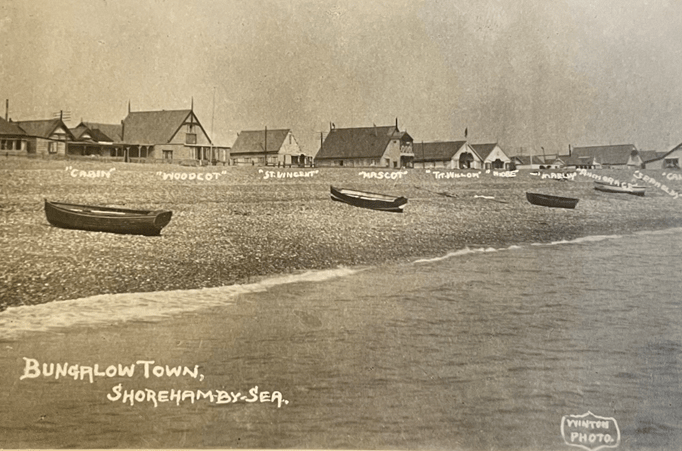
Variations included added porches or verandas and divisions removed or added. The plots on which they were built were leased at a uniformed size of 60ft were leased, with anyone wishing to build a larger residence leasing multiple plots.
Marie Loftus had many friends in the business and when they appeared in Brighton Theatres, she would invite them down to ‘Cecilia’ resulting in many friends having their own bungalows built. An artistic colony grew, theatre owners, performers, artists (including Sir Walter Russell and the poster artist E.P Kinsella), comedians, managers, concert singers started to inhabit Bungalow Town.
“since the first few bungalows were erected the town has grown each year not only in size but the form of architecture has been gradually elaborated”
The Tatler – Wed 7 August 1907
Marie Loftus later upgraded her bungalow, building the ‘Pavlova’, an imposing building with many rooms, with descriptions noting that dining room table had 24 chairs!
Life in Bungalow Town
Residents before the 1920s would be without water, gas, electricity, sewers and drainage. Water was brought from the mainland and sold per bucket to supplement collected rainwater. Oil lamps were used for light and fuelled stoves for cooking. Still, there were two deliveries of letters per day and most postmen carried stamps with them for the convenience of dwellers.
Church of the Good Sheppard
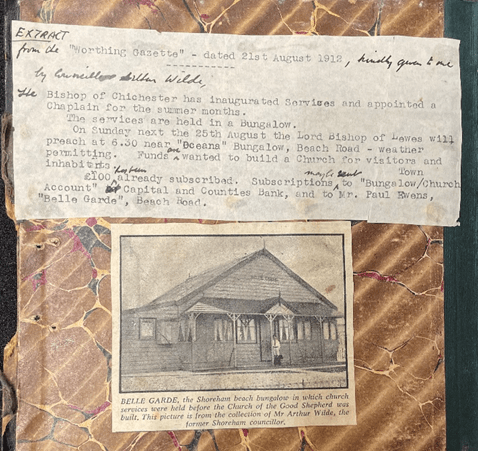
Following a Beach Mission in 1912, in which a congregation of 200 formed in the beach, it was decided that a chapel of ease would be built.
By February 1913 the site was selected and the plans drawn. Five months later the Church of the Good Shepard Church was built and on 16 July 1913, it was dedicated by the Rt. Revd Charles Ridgeway, the Bishop of Chichester.
Bungalow Town in WWI
During WWI Marie Loftus’ ‘Pavlova’ became the officers mess for the Royal Flying Corps and Bungalow Town became a retreat for wounded soldiers were hosted by inhabitants.
“Mrs Buxton Catchpole, who is renting one of the pretty bungalows on Shoreham beach this summer, twice a week entertains a party of wounded soldiers from the Brighton Military Hospitals… The men greatly enjoy their afternoons at Bungalow Town and have their tea on the beach and sit for hours enjoying the sunshine and ozone laden breezes. Among the guests at Mrs Catchpole’s party on Tuesday was Private Houlgate of Stratchcona’s Horse, who is returning to the front on Monday”
Brighton Gazette – Sat 15 May 1915
After WWI, roads were built and gas and electricity arrived. The Shoreham-by-Sea and Lancing Electric Lighting Special Order 1921 shows the special powers granted for this unconventional town:
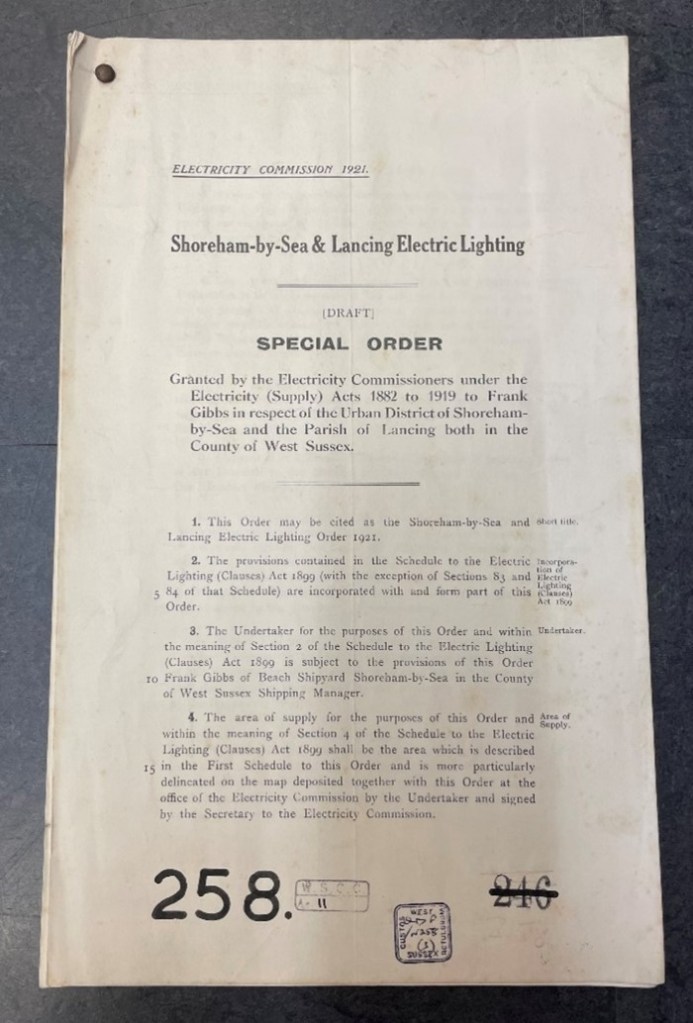
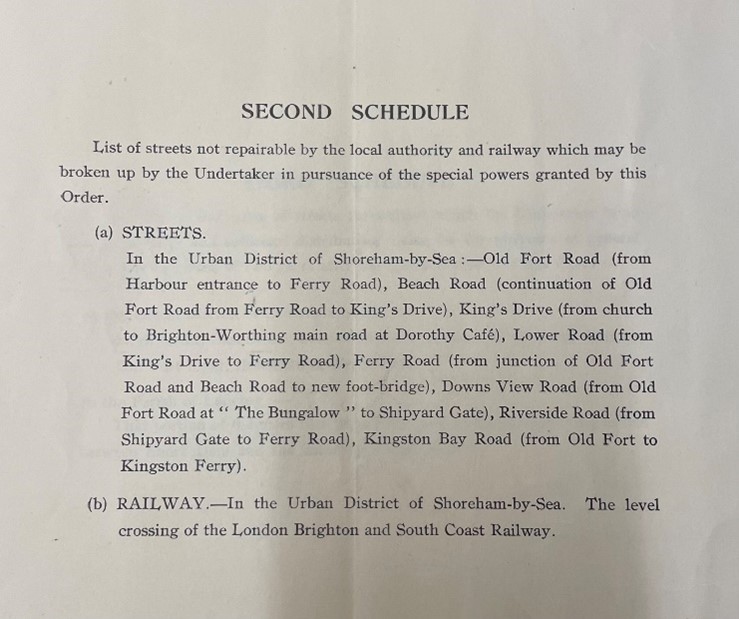
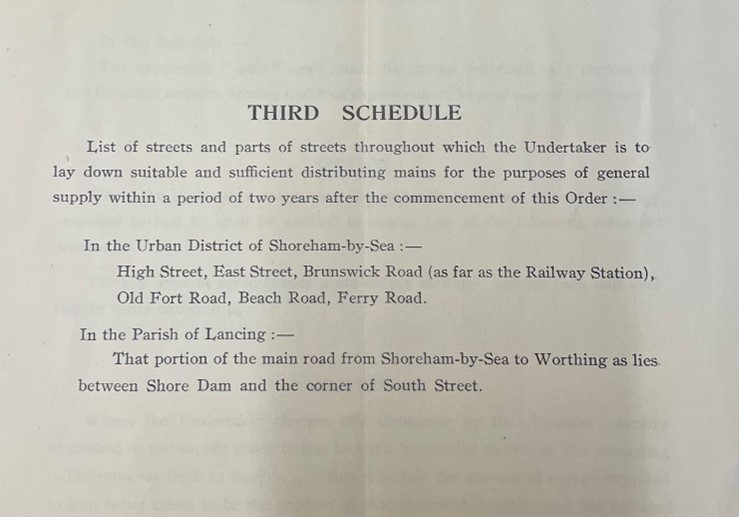
QDP/W258B
The growing of the town
Bungalow Town grew rapidly, by 1900 there were 120 dwellings on the beach, and by 1909 there were 200.
“It is really remarkable the way in which Bungalow Town is expanding. On Tuesday the Shoreham-by-Sea Urban Council approved a large number of plans, and in previous months there have been many plans of residences on Shoreham’s popular beach. A big town is springing up there. If people who have been away from the ancient town a few years were to visit their old haunts again they would certainly be surprised at the development which bungalow Town has witnessed and is witnessing. There is no stopping it. Elsewhere in Shoreham too”
Brighton Gazette – Sat 6 June 1914
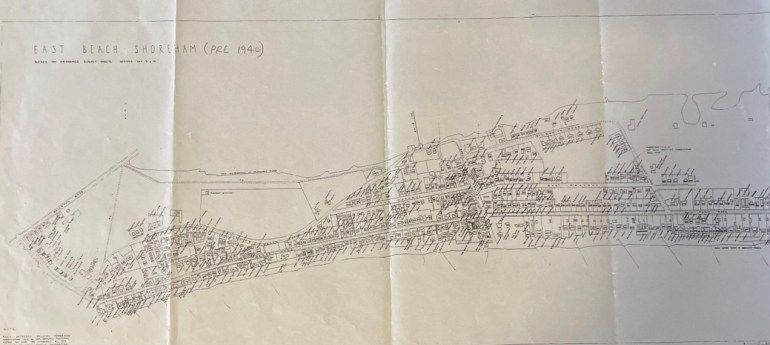
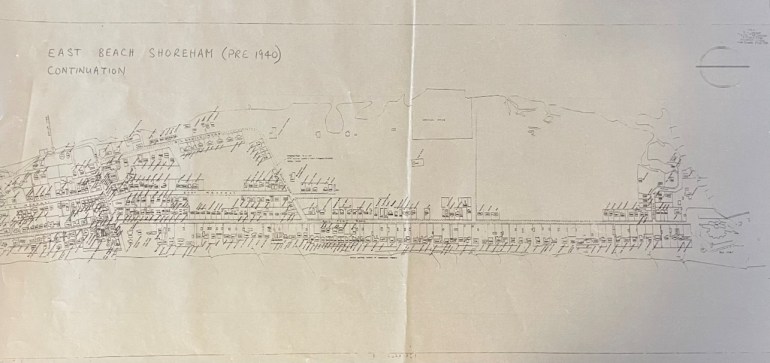
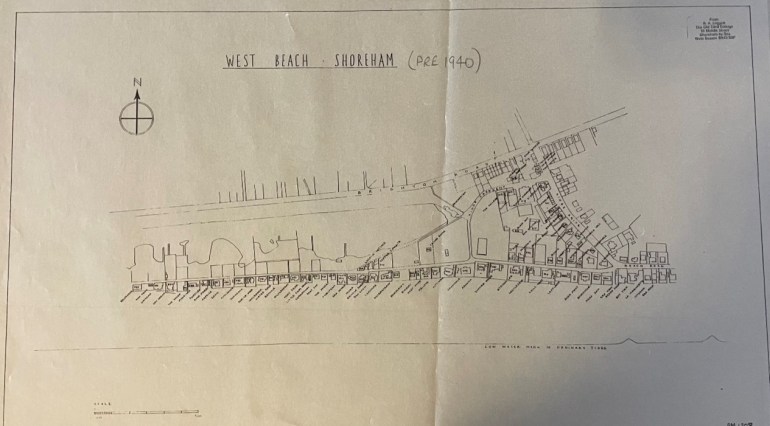
As Bungalow Town grew, more amenities started to arrive. Bungalow Stores, Ferry Road opened by Mr Pike would be the first shop to open, supplying all requirements for the semi-isolated community.
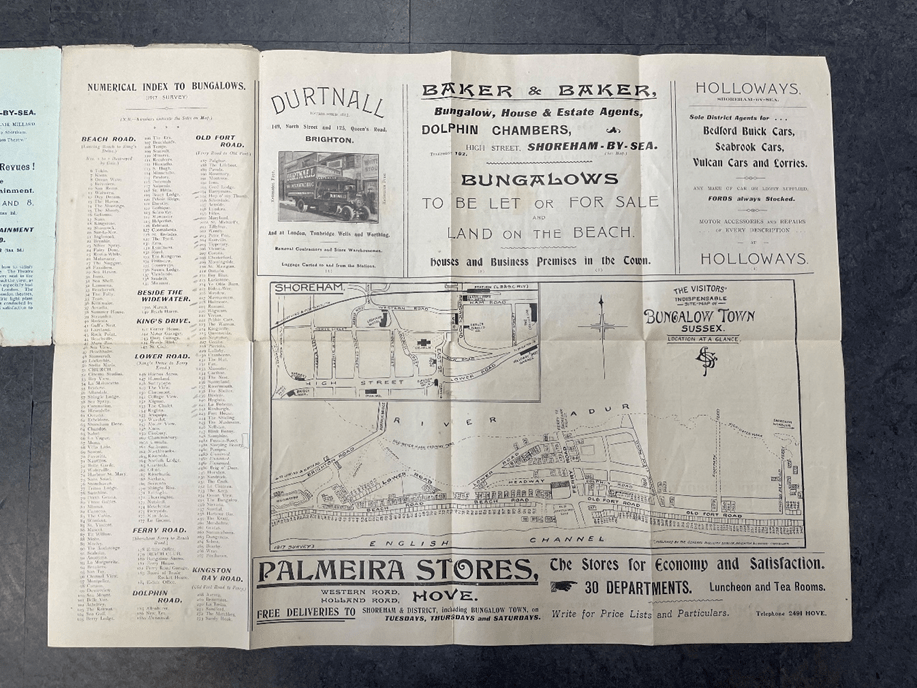
Flos beach club (a club come dance hall) provided a centre for social life on the beach for residences and holiday-makers.
Bungalow Town’s increasing number of residences were becoming increasingly temporary, the lifestyle appealing to holidaymakers looking for a cheap family break in the summer months.
“It is worth noting as a place where quiet and most unconventional holidays may be enjoyed in a kind of picnic fashion, yet within easy reach of town by the Brighton line… when the tide is out there is a rather muddy slope to negotiate, but never mind there are a number of willing boatmen waiting your patronage, who will ferry you over in a couple of minutes for the small sum of one penny, and another two minutes walk will bring you to Shoreham beach, locally known as Bungalow Town”
Gentlewoman – Sat 2 September 1911
The Fragility of Bungalow Town
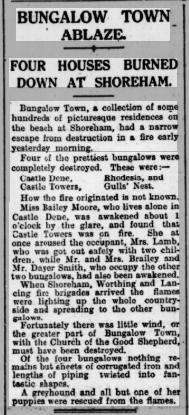
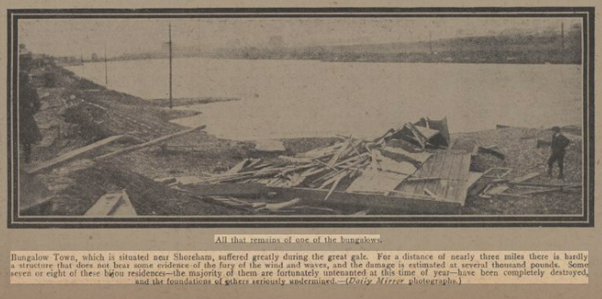
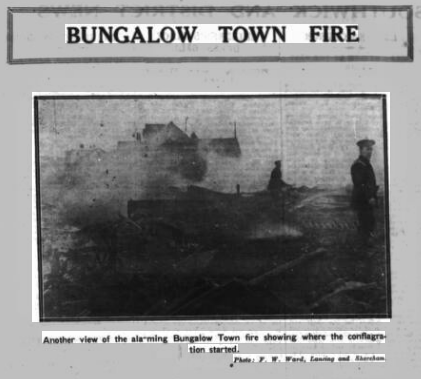
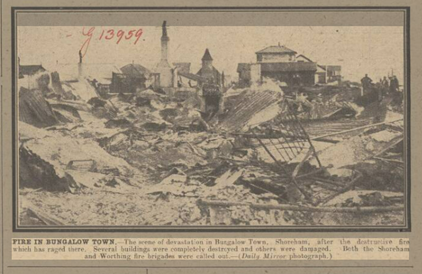
The basic structures of the bungalows and their proximity to the sea with minimal flood defences saw severe damage during winter storms. The area also experienced many devastating fires, the fire station located on the other side of Norfolk bridge, having frequent call outs to the area.
WWII and end of Bungalow Town
In August 1940, just under a year into World War II, residences we were given 48 hours by the War Office to clear the beach as it was feared that German soldiers could use the area to gain access to the town using the bungalows as cover.
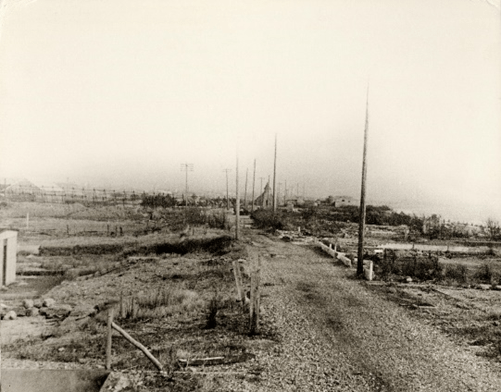
Larger bungalows were blown up by the Army and smaller bungalows boarded up, The Church of the Good Shepard Church narrowly escaping destruction. Residents were put into rented accommodation on the mainland. It was long after the war had ended before permission was given for people to return to the beach.
Part 2 is now live!
Stay up to date with WSRO – follow us on Facebook, Instagram, Threads, Bluesky and YouTube

 West Sussex Record Office
This is great, thanks so much for this interesting post. Reusing railway carriages as the basis for buildings strikes me as a good way of recycling materials to build homes – we could do with more of this today!
There’s still several examples of railway carriage bungalows on the Sussex Coast – I like spotting them on my walks. Some are obvious but others hiding behind rendering and connecting walls. House names, common lengths and familiar window heights/shapes are good exterior clues.
A few at Shoreham Beach have either survived or were reinstated but elsewhere in Sussex there are at least 3 on the short stretch at Park Copse in Selsey, twice that number on the West side of East Wittering, a few at Felpham and many, many more at Pagham.
LikeLiked by 1 person